Chandra (Moon) Mantra
ॐ श्रां श्रीं श्रौं सः चंद्राय नमः॥
Om śrāṁ śrīṁ śrauṁ saḥ candrāya namaḥ॥
Om. Salutations to Chandra (the Moon God).
Meaning
This mantra is a potent Bija (seed) mantra for Chandra, the Moon God. The Bija sounds śrāṁ, śrīṁ, and śrauṁ are specific vibrational energies associated with Chandra, invoking his blessings. The mantra concludes with a salutation, offering reverence to Chandra for his benevolent influence.
Benefits
- Attains mental peace and tranquility
- Improves emotional stability and balance
- Enhances intuition and creativity
- Alleviates troubles related to the mind and emotions
- Promotes harmony in relationships
- Bestows good health and well-being
- Neutralizes negative effects of a malefic Moon in one’s astrological chart
Who Should Chant This
- Individuals seeking mental peace and emotional balance
- Those suffering from anxiety, depression, or mood swings
- People with a weak or afflicted Moon in their birth chart
- Artists, writers, and creative individuals
- Anyone wishing to enhance their intuition and psychic abilities
- Those experiencing relationship difficulties
When to Chant
Chant this mantra daily, especially during the waxing phase of the moon (Shukla Paksha), on Mondays (which are ruled by the Moon), or during Chandra-specific planetary hours (Hora). It is particularly beneficial to chant after taking a bath in the morning, facing the northeast direction.
Suggested Count
Chant 108 times (one mala) daily, or multiples thereof. A total of 11,000 or 125,000 repetitions over a period are often recommended for significant astrological remediation.
Story & Origin
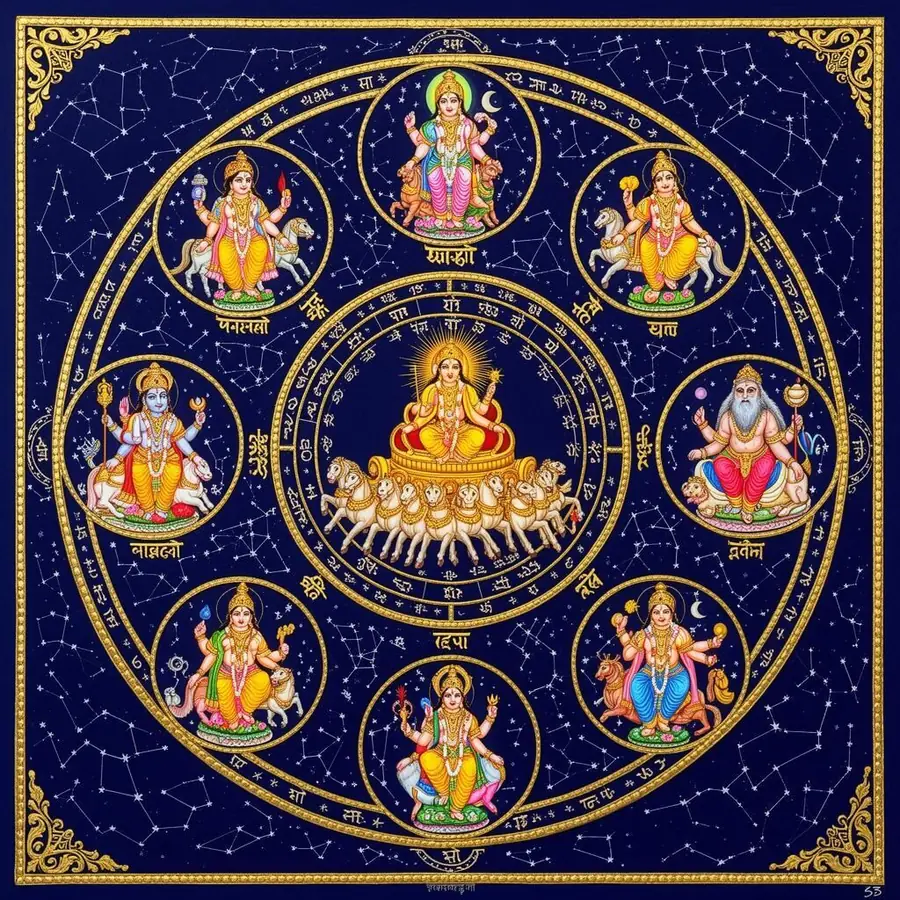
In Hindu mythology, Chandra, the Moon God, is born from the mind of Lord Brahma, or sometimes from the ocean during the Samudra Manthan (churning of the cosmic ocean). He is depicted as youthful, fair-complexioned, and seated on a chariot drawn by ten white horses. He is the lord of medicinal herbs, mind, emotions, and beauty. He married the 27 daughters of Daksha Prajapati, who are the 27 Nakshatras (lunar mansions). Due to his favoritism towards Rohini, Daksha cursed him to wane, but due to the intervention of Shiva, the curse was mitigated, allowing him to wax and wane cyclically, thus maintaining the balance of creation.
Sources & references
- Published Sanskrit mantra collections and nāmāvaliḥ editionsUsed for the Devanāgarī text and transliteration reproduced above.
- Received oral and temple traditiontraditional attribution, not textually verifiedSource of the chanting timings, counts and observances described on this page.
Translation and interpretation: Sanskrit names and verses are given in transliteration with a working English rendering. Where a name carries several defensible readings, we give the most common one and mark it as a gloss rather than a literal, one-to-one translation. Interpretive commentary is our own and is kept separate from the text itself.
Some material on this page circulates in oral and printed tradition without a settled critical edition. Those entries are flagged above; we state the tradition it is received from rather than asserting a chapter and verse we cannot verify.
The benefits described here are those the devotional tradition associates with this mantra. They are stated as tradition, not as medical, psychological, financial or legal outcomes, and chanting is not a substitute for professional care. Meanings are working renderings rather than literal word-for-word translations.
How to chant any Vedic mantra well
The mantra above is the inheritance. What follows is the instruction manual — how to sit, when to start, how to count, and how to make a practice that lasts longer than your initial enthusiasm.
The 96 minutes before sunrise — the Brahma Muhurta — is the classical window. Sunset is the second window. Failing both, the time of day you will actually return to without negotiation.
A clean corner, an upright spine, hands at rest on the knees or on a mala, eyes soft-closed. Face east or north. Take three slow breaths to settle, then begin.
A mala has 108 beads plus a guru bead. Pass each bead with the thumb against the middle finger; do not cross the guru bead — reverse direction at the end of each round. Eleven repetitions is a respected starting commitment.
Start audible (vaikhari) so the breath and pronunciation align. Move to whispered (upamshu) once the mantra feels familiar. The highest mode is mental (manasika) — reserved for established practitioners.
The first week of daily chanting usually settles the breath and quiets surface anxiety. The first month begins to shift sleep, concentration and the texture of relationships. After a hundred days the mantra starts to repeat itself in idle moments — this is called ajapa, the unbroken silent stream. None of this is guaranteed; all of it is reported by sincere practitioners across centuries.
Resist the urge to track results. The fruit of mantra is in the discipline of returning, not in graphs and milestones.
A Sanskrit mantra is not a sentence to be parsed — it is a composition of root sounds (bija aksharas) whose vibration is believed to be the active ingredient. The English translation given above is one reasonable reading; the Sanskrit will carry shades of meaning no translation captures. Hold both lightly: the translation is for the mind, the sound is for everything else.
- Mantra practice complements, but does not replace, medical, psychological or legal advice.
- If you live with severe anxiety, trauma or psychosis, begin gently and ideally under the guidance of an experienced teacher.
- Avoid loud chanting at unsocial hours — whispered or mental modes exist for exactly this.
- Treat printed Sanskrit text with respect; tradition asks that you not place it on the floor or carry it into a bathroom.
Mantra practice, plainly answered
Do I have to be Hindu to chant a Vedic mantra?
No. Vedic mantras are sound-bodies that work through vibration, intention and repetition. Many practitioners around the world — Hindu, Buddhist, Christian, secular — chant them as a meditation practice without subscribing to any specific theology. We ask only that you approach the sound respectfully and pronounce it as accurately as you can.
How do I pronounce Sanskrit correctly if I don't read Devanagari?
Use the transliteration on this page as your starting point, then listen to several recordings to internalise the rhythm. Sanskrit pronunciation is largely phonetic: each letter is voiced as written, vowels are either short (a, i, u) or long (ā, ī, ū), and the syllables flow on the breath. Imperfect pronunciation does not invalidate practice — sustained attention does.
How many times should I chant?
Tradition recommends multiples of 108 for completeness — 108 corresponds to the beads of a mala. Common counts are 11 (one round of slow chanting), 27 (a quarter mala), 108 (one mala), or 1,008 (ten malas, typically done over several sittings). Daily consistency matters far more than total volume.
Is there a best time to chant?
The Brahma Muhurta — the 96 minutes before sunrise — is considered the most receptive window in the day. Sunset is the second-best window. That said, the best time is the time you will actually show up: a five-minute practice you do every day beats an hour-long session you skip after a week.
Should I chant out loud or silently?
Tradition recognises three modes: vaikhari (audible), upamshu (whispered) and manasika (mental). Audible chanting is recommended for beginners because it disciplines breath and pronunciation. As the mantra becomes familiar, many practitioners shift to whispered or mental repetition.
Can I chant on an empty stomach? Do I need to sit a particular way?
An empty or lightly-fed stomach is preferred — heavy digestion fights concentration. Sit upright on the floor or on a chair with a straight spine, hands resting in the lap or on a mala. Face east or north when possible. None of this is required; comfort and consistency are.
Do I need initiation (diksha) from a guru?
For most public mantras — Gayatri, Mahamrityunjaya, the Hanuman Chalisa, Vishnu Sahasranama, the navagraha bija mantras — you can begin practice on your own. Certain tantric and shakta mantras traditionally require initiation. When in doubt, start with the openly-shared mantras on this site and seek a qualified teacher if you wish to go deeper.