Tripura Sundari Mantra
ऐं ह्रीं श्रीं त्रिपुर सुंदरीये नमः॥
Aim Hrīṁ Śrīṁ Tripura Sundarīye Namaḥ
Salutations to Tripura Sundari, who is the primordial sound (Aim), the remover of suffering (Hrim), and the abundance of divine grace (Shrim).
Meaning
This mantra invokes the divine mother Tripura Sundari, the most beautiful in the three worlds. 'Aim' represents the Saraswati Bija, the source of knowledge and creativity. 'Hrim' is the Maya Bija, signifying the power to manifest desires and remove illusions. 'Shrim' is the Lakshmi Bija, bestowing wealth, prosperity, and auspiciousness. Together, these Bīja mantras honor Tripura Sundari as the supreme cosmic power, the embodiment of beauty, grace, and ultimate reality.
Benefits
- Attainment of spiritual knowledge and wisdom
- Access to divine beauty and aesthetic appreciation
- Fulfillment of desires and aspirations
- Removal of obstacles and negativities
- Attainment of peace, prosperity, and liberation
Who Should Chant This
- Devotees seeking spiritual enlightenment
- Those aspiring for beauty, grace, and charm
- Individuals desiring material and spiritual prosperity
- Students and artists for enhanced creativity and wisdom
- Seekers wishing to overcome challenges and attain liberation
When to Chant
Ideally, during Brahma Muhurta (early morning before sunrise) or at sunset. It can also be chanted during any auspicious time, especially on Fridays or during Navaratri.
Suggested Count
108 times daily, or in multiples thereof, for a minimum of 40 days (a mandala). For advanced practitioners, 1,25,000 repetitions are recommended for Siddhi.
Story & Origin
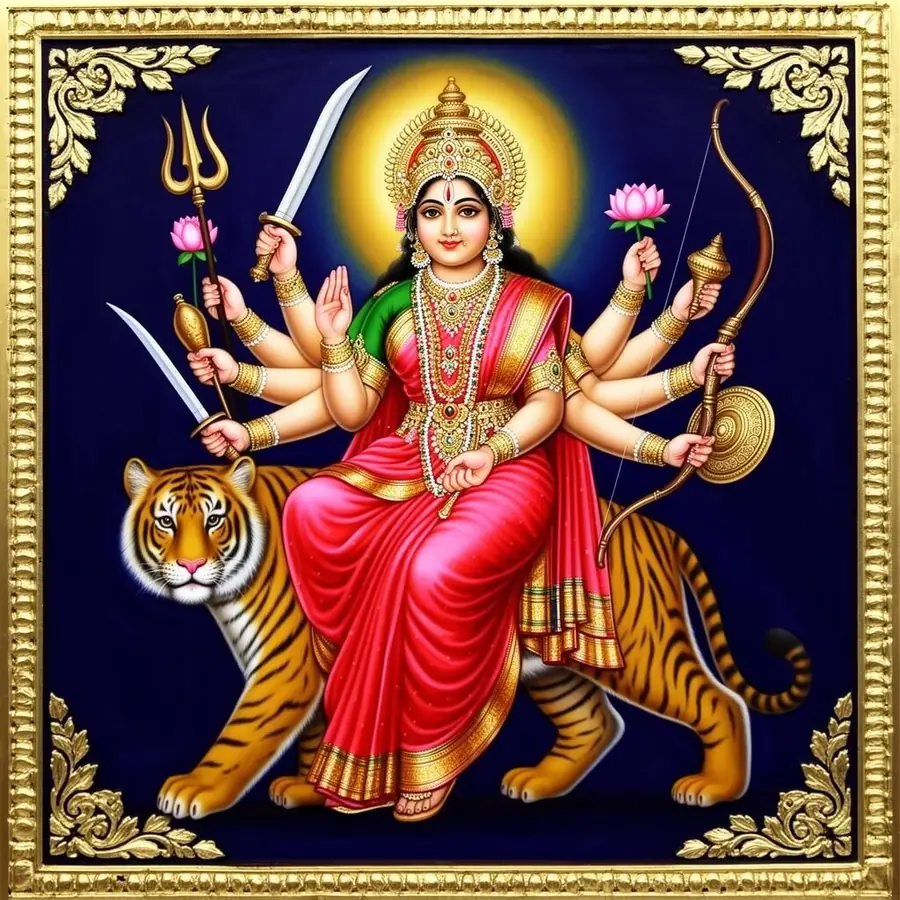
Tripura Sundari, also known as Lalita Tripurasundari, is the supreme deity of the Srikula system of Shaktism, revered as the Para Shakti (Supreme Energy). She is often depicted as a sixteen-year-old girl, representing eternal youth and beauty, seated on a lotus, which rests on a supine Shiva. This symbolizes her absolute supremacy over Shiva and the entire cosmos. Her story is deeply intertwined with the creation and sustenance of the universe, and she is considered the source of all mantras and tantras. She is the ultimate consciousness that pervades the three worlds (Tripura) and is the epitome of exquisite beauty (Sundari). Her worship is elaborate, involving the potent Sri Chakra Yantra, which visualizes her cosmic form.
Sources & references
- Published Sanskrit mantra collections and nāmāvaliḥ editionsUsed for the Devanāgarī text and transliteration reproduced above.
- Received oral and temple traditiontraditional attribution, not textually verifiedSource of the chanting timings, counts and observances described on this page.
Translation and interpretation: Sanskrit names and verses are given in transliteration with a working English rendering. Where a name carries several defensible readings, we give the most common one and mark it as a gloss rather than a literal, one-to-one translation. Interpretive commentary is our own and is kept separate from the text itself.
Some material on this page circulates in oral and printed tradition without a settled critical edition. Those entries are flagged above; we state the tradition it is received from rather than asserting a chapter and verse we cannot verify.
The benefits described here are those the devotional tradition associates with this mantra. They are stated as tradition, not as medical, psychological, financial or legal outcomes, and chanting is not a substitute for professional care. Meanings are working renderings rather than literal word-for-word translations.
How to chant any Vedic mantra well
The mantra above is the inheritance. What follows is the instruction manual — how to sit, when to start, how to count, and how to make a practice that lasts longer than your initial enthusiasm.
The 96 minutes before sunrise — the Brahma Muhurta — is the classical window. Sunset is the second window. Failing both, the time of day you will actually return to without negotiation.
A clean corner, an upright spine, hands at rest on the knees or on a mala, eyes soft-closed. Face east or north. Take three slow breaths to settle, then begin.
A mala has 108 beads plus a guru bead. Pass each bead with the thumb against the middle finger; do not cross the guru bead — reverse direction at the end of each round. Eleven repetitions is a respected starting commitment.
Start audible (vaikhari) so the breath and pronunciation align. Move to whispered (upamshu) once the mantra feels familiar. The highest mode is mental (manasika) — reserved for established practitioners.
The first week of daily chanting usually settles the breath and quiets surface anxiety. The first month begins to shift sleep, concentration and the texture of relationships. After a hundred days the mantra starts to repeat itself in idle moments — this is called ajapa, the unbroken silent stream. None of this is guaranteed; all of it is reported by sincere practitioners across centuries.
Resist the urge to track results. The fruit of mantra is in the discipline of returning, not in graphs and milestones.
A Sanskrit mantra is not a sentence to be parsed — it is a composition of root sounds (bija aksharas) whose vibration is believed to be the active ingredient. The English translation given above is one reasonable reading; the Sanskrit will carry shades of meaning no translation captures. Hold both lightly: the translation is for the mind, the sound is for everything else.
- Mantra practice complements, but does not replace, medical, psychological or legal advice.
- If you live with severe anxiety, trauma or psychosis, begin gently and ideally under the guidance of an experienced teacher.
- Avoid loud chanting at unsocial hours — whispered or mental modes exist for exactly this.
- Treat printed Sanskrit text with respect; tradition asks that you not place it on the floor or carry it into a bathroom.
Mantra practice, plainly answered
Do I have to be Hindu to chant a Vedic mantra?
No. Vedic mantras are sound-bodies that work through vibration, intention and repetition. Many practitioners around the world — Hindu, Buddhist, Christian, secular — chant them as a meditation practice without subscribing to any specific theology. We ask only that you approach the sound respectfully and pronounce it as accurately as you can.
How do I pronounce Sanskrit correctly if I don't read Devanagari?
Use the transliteration on this page as your starting point, then listen to several recordings to internalise the rhythm. Sanskrit pronunciation is largely phonetic: each letter is voiced as written, vowels are either short (a, i, u) or long (ā, ī, ū), and the syllables flow on the breath. Imperfect pronunciation does not invalidate practice — sustained attention does.
How many times should I chant?
Tradition recommends multiples of 108 for completeness — 108 corresponds to the beads of a mala. Common counts are 11 (one round of slow chanting), 27 (a quarter mala), 108 (one mala), or 1,008 (ten malas, typically done over several sittings). Daily consistency matters far more than total volume.
Is there a best time to chant?
The Brahma Muhurta — the 96 minutes before sunrise — is considered the most receptive window in the day. Sunset is the second-best window. That said, the best time is the time you will actually show up: a five-minute practice you do every day beats an hour-long session you skip after a week.
Should I chant out loud or silently?
Tradition recognises three modes: vaikhari (audible), upamshu (whispered) and manasika (mental). Audible chanting is recommended for beginners because it disciplines breath and pronunciation. As the mantra becomes familiar, many practitioners shift to whispered or mental repetition.
Can I chant on an empty stomach? Do I need to sit a particular way?
An empty or lightly-fed stomach is preferred — heavy digestion fights concentration. Sit upright on the floor or on a chair with a straight spine, hands resting in the lap or on a mala. Face east or north when possible. None of this is required; comfort and consistency are.
Do I need initiation (diksha) from a guru?
For most public mantras — Gayatri, Mahamrityunjaya, the Hanuman Chalisa, Vishnu Sahasranama, the navagraha bija mantras — you can begin practice on your own. Certain tantric and shakta mantras traditionally require initiation. When in doubt, start with the openly-shared mantras on this site and seek a qualified teacher if you wish to go deeper.