604 Names of Lord Jagannātha
The complete Śrī Jagannātha Sahasranāma Stotram of the Brahma Purāṇa — spoken by Bhīṣma to Yudhiṣṭhira in the Bhīṣma–Yudhiṣṭhira saṃvāda — beginning caturbhujo jagannāthaḥ and closing with jagadīśo mahadbrahma jagannāthāya te namaḥ. All 604 names of the received recension (82 ślokas) are given here in Sanskrit (Devanāgarī), IAST transliteration and English meaning, in their exact scriptural order.
The History of Lord Jagannath & the Puri Temple
The story of Lord Jagannath is recorded principally in the Skanda Purāṇa, Utkala Khaṇḍa (the Puruṣottama Kṣetra Māhātmya), with parallel accounts in the Niladri Mahodaya, the Brahma Purāṇa, and the Padma Purāṇa. The narrative is not myth in the modern sense — it is the traditional Vaiṣṇava record of how the Supreme Lord chose to appear on earth as dāru‑brahma, the Brahman embodied in sacred wood, so that any being — of any caste, tribe, gender or nation — could look upon Him with their own eyes and be liberated.
1 · King Indradyumna & Nīla Mādhava
The pious King Indradyumna of Avantī (Malwā), a great devotee of Viṣṇu, hears of a supremely secret form of the Lord worshipped in the forests of Utkala (Odisha) — Nīla Mādhava, a sapphire‑blue Viṣṇu hidden in a cave on Nīlācala hill. He sends emissaries in every direction. Only the Brahmin Vidyāpati succeeds — he befriends the Śabara tribal chief Viśvāvasu, the sole hereditary worshipper of Nīla Mādhava, and is at last led blindfolded to the shrine. But when King Indradyumna arrives, the deity has vanished, buried under drifting sand — a sign that the Lord will now appear anew, in a form for the whole world.
2 · The Dāru‑Brahma on the Shore
In a dream Lord Viṣṇu instructs Indradyumna: a great fragrant dāru (log of divine wood), marked with the conch, discus, mace and lotus, will drift ashore at Bāṅkī Muhāna. From this single log, the images of the Lord are to be carved. The log arrives exactly as foretold. No artisan can cut it. An old carpenter appears — Viśvakarmā Himself, in disguise — and agrees to carve the mūrtis on one condition: the door of the sanctum must remain shut for twenty‑one days, and no one may look inside.
3 · The Unfinished Form
Queen Guṇḍicā, hearing no sound of tools for many days, fears the old artisan has died. The door is opened before the appointed time. Viśvakarmā departs at once — and the three deities remain forever as they were then, with round luminous eyes, stump‑arms and no hands or feet. This is the intentional abhaya‑rūpa: the formless Brahman condescending to a form so minimal, so childlike, that no philosophy and no caste and no learning is required to love Him. The unfinished form is the message.
4 · The Trinity of Nīlācala
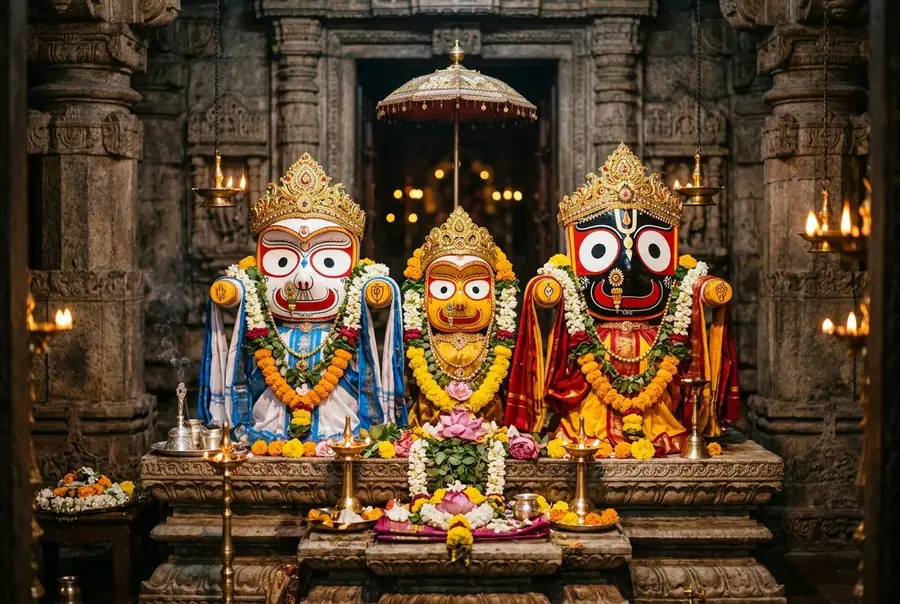
On the Ratna Vedī sit three: Śrī Jagannātha (black‑hued, Kṛṣṇa Himself, the ātman), Balabhadra (white‑hued, Balarāma, the primal Ādi‑Śeṣa and consciousness), and Devī Subhadrā (golden‑yellow, the śakti, seated between the two brothers). Beside them stands Sudarśana as a pillar — the discus of Viṣṇu, guardian of dharma. Together they are the complete Brahman: sat, cit, ānanda.
5 · The Śrī Mandira of Puri
The present stone temple — the Śrī Mandira — was built in the 12th century CE by Anantavarman Chodagaṅga Deva of the Eastern Gaṅga dynasty, and completed by Anaṅgabhīma Deva III in the 13th century. Its towering śikhara rises 214 feet above Nīlācala hill. The temple survived repeated invasions; the deities were hidden many times and always returned. Puri is one of the four Char Dhām established in the four directions of India — Badrinath (north), Dwarka (west), Rameswaram (south), and Puri (east) — and the seat of Govardhana Maṭha of Ādi Śaṅkarācārya.
6 · Ratha Yātrā & Nabakalebara
Once every year, in the bright fortnight of Āṣāḍha, the Lord Himself steps out of His temple. On three colossal wooden chariots — Nandighoṣa, Tāladhvaja, and Darpadalana — Jagannātha, Balabhadra and Subhadrā ride to the Guṇḍicā Temple to visit their birthplace. This is the Ratha Yātrā, and to touch the rope of that chariot is said to grant the fruit of a thousand horse‑sacrifices. In rare years when the month of Āṣāḍha doubles (roughly every 12–19 years), the mūrtis themselves are renewed in the secret rite of Nabakalebara — a fresh dāru is identified by ancient signs, the Brahma‑padārtha (the eternal soul of the Lord) is transferred at midnight by blindfolded priests, and the Lord walks again in a new body. The wood changes; the Lord is unchanging.
Primary scriptural sources: Skanda Purāṇa, Utkala Khaṇḍa (Puruṣottama Kṣetra Māhātmya) · Brahma Purāṇa, Bhīṣma–Yudhiṣṭhira saṃvāda (the source of this Sahasranāma) · Niladri Mahodaya · Padma Purāṇa. Historical dating follows the epigraphic record of the Eastern Gaṅga dynasty inscriptions preserved at the Śrī Mandira and studied in modern Odishan temple history.
The 604 Sacred Names
- चतुर्भुजः#1caturbhujaḥ
The four-armed Lord, who in His majestic form wields the conch, discus, mace, and lotus, symbolizing His cosmic powers of creation, preservation, and dissolution.
- जगन्नाथः#2jagannāthaḥ
The Lord of the Universe, who is the supreme master, sustainer, and ultimate destination of all beings and worlds within the entire cosmos.
- कण्ठशोभितकौस्तुभः#3kaṇṭhaśobhitakaustubhaḥ
He whose neck is adorned with the brilliant Kaustubha gem, which emerged from the ocean churning and represents the pure, untainted consciousness of all living souls.
- पद्मनाभः#4padmanābhaḥ
He from whose navel sprouts a divine lotus, which serves as the birthplace of Lord Brahmā, signifying that He is the ultimate source of cosmic creation.
- वेदगर्भः#5vedagarbhaḥ
He who holds the entire corpus of Vedic knowledge within His womb, indicating that all eternal truths and sacred revelations originate from and reside within Him.
- चन्द्रसूर्यविलोचनः#6candrasūryavilocanaḥ
He whose eyes are the sun and the moon, a depiction of His cosmic form (Viśvarūpa) through which He illuminates and watches over the entire universe.
- जगन्नाथः#7jagannāthaḥ
The Lord of the Universe, who is the supreme sovereign and refuge for all of creation, governing its existence and guiding it towards righteousness.
- लोकनाथः#8lokanāthaḥ
The Lord of all realms (lokas), who is the supreme master and shelter for all beings across every plane of existence in the vast cosmos.
- नीलाद्रीशः#9nīlādrīśaḥ
The Lord of the Blue Mountain (Nīlādri), specifically identifying Him with His sacred abode at Puri, the Nīlācala, where He eternally resides for His devotees.
- परः#10paraḥ
The Supreme and Transcendent One, who exists beyond all material limitations, causes, and effects, representing the ultimate, absolute, and highest reality.
- हरिः#11hariḥ
The one who removes all suffering, sin, and obstacles from the path of His devotees, liberating them from the cycle of birth and death.
- दीनबन्धुः#12dīnabandhuḥ
The friend of the humble, helpless, and afflicted, to whom He extends His special grace and protection, offering solace in times of distress.
- दयासिन्धुः#13dayāsindhuḥ
An ocean of mercy, whose compassion is as boundless and deep as the great ocean, available to all souls without any cause or condition.
- कृपालुः#14kṛpāluḥ
The one who is inherently compassionate, whose very nature is to bestow causeless grace and mercy upon all living entities, especially His surrendered devotees.
- जनरक्षकः#15janarakṣakaḥ
The protector of all people, who tirelessly guards His devotees and all righteous beings from every kind of danger, fear, and adversity.
- कम्बुपाणिः#16kambupāṇiḥ
He who holds the conch (kambu) in His hand, referring to the Pāñcajanya, whose divine sound proclaims victory and dispels fear from the hearts of devotees.
- चक्रपाणिः#17cakrapāṇiḥ
He who wields the discus (cakra) in His hand, referring to the Sudarśana Chakra, a symbol of righteous protection that vanquishes evil and safeguards dharma.
- पद्मनाभः#18padmanābhaḥ
He from whose navel a lotus blossoms, upon which sits Brahmā, the creator, illustrating His position as the ultimate origin of the entire creative process.
- नरोत्तमः#19narottamaḥ
The best among men, who, though appearing in a human-like form, is the Supreme Person (Puruṣa) and the perfect ideal for all humanity to emulate.
- जगतांपालकः#20jagatāmpālakaḥ
The protector of the worlds, who sustains and maintains the cosmic order, ensuring the welfare and preservation of all the universal realms He has created.
- व्यापी#21vyāpī
The all-pervading one, who is immanent throughout creation, present in every atom and every being, yet simultaneously transcending all.
- सर्वव्यापी#22sarvavyāpī
He who pervades absolutely everything, an emphasis on His total and unconditional immanence in both the manifest and unmanifest aspects of existence.
- सुरेश्वरः#23sureśvaraḥ
The Lord of the gods (suras), who is the supreme master of all celestial deities like Indra and Varuṇa, who derive their powers from Him.
- लोकराजः#24lokarājaḥ
The King of all worlds, who is the supreme sovereign ruler over all planetary systems, whose divine laws govern the entire cosmos and its inhabitants.
- देवराजः#25devarājaḥ
The King of the demigods, who holds ultimate authority over the celestial realms, with all deities acting as His ministers in the cosmic administration.
- शक्रः#26śakraḥ
The powerful one, an epithet of Indra, indicating that as the Supreme Lord, He is the ultimate Indra, possessing unequalled power and authority.
- भूपः#27bhūpaḥ
The king and protector of the Earth, who is the ultimate sovereign responsible for maintaining terrestrial order, protecting its inhabitants, and upholding righteousness.
- भूपतिः#28bhūpatiḥ
The Lord of the Earth, who is the supreme owner and master of the entire planet, with all worldly kings and rulers being merely His representatives.
- नीलाद्रिपतिः#29nīlādripatiḥ
The Master of the Blue Mountain, a name that specifically emphasizes His absolute sovereignty over His sacred dwelling place, the Nīlācala in Puri.
- नाथः#30nāthaḥ
The Lord and ultimate Refuge, to whom all beings turn for shelter, protection, and guidance, and who graciously accepts all who seek Him.
- अनन्तः#31anantaḥ
The endless and infinite one, who is without beginning or end in terms of time, space, or attributes, representing the boundless nature of the Absolute Truth.
- पुरुषोत्तमः#32puruṣottamaḥ
The Supreme Person, who, as explained in the Bhagavad Gītā, transcends both the perishable material world (kṣara) and the imperishable soul (akṣara).
- तार्क्ष्यारूढः#33tārkṣyārūḍhaḥ
He who is mounted on Tārkṣya (Garuḍa), depicting His majestic form as the Lord of Vaikuṇṭha, riding His divine eagle who symbolizes Vedic authority.
- कल्पतरुः#34kalpataruḥ
The wish-fulfilling celestial tree, who, like the divine Kalpavṛkṣa, generously grants all the spiritual and material desires of His sincere devotees.
- विमलाप्रीतिवर्धनः#35vimalāprītivardhanaḥ
He who increases the delight of Goddess Vimalā, highlighting His intimate, loving relationship with His consort, the principal śakti of the Jagannātha temple.
- बलभद्रः#36balabhadraḥ
He who is also Balabhadra, indicating the non-difference between Lord Jagannātha and His elder brother, who are worshipped together as part of the divine trinity in Puri.
- वासुदेवः#37vāsudevaḥ
The son of Vasudeva, referring to His celebrated incarnation as Śrī Kṛṣṇa, and also meaning the one who pervades and resides within everything.
- माधवः#38mādhavaḥ
The husband of Mā (Goddess Lakṣmī), and a descendant of the Madhu clan, who is as sweet as honey (madhu) to His beloved devotees.
- मधुसूदनः#39madhusūdanaḥ
The slayer of the demon Madhu, a primordial act through which He rescued the Vedas from the netherworlds and re-established cosmic order at the dawn of creation.
- दैत्यारिः#40daityāriḥ
The divine enemy of the Daityas, a clan of powerful demons whom He vanquishes in various incarnations to protect cosmic order.
- पुण्डरीकाक्षः#41puṇḍarīkākṣaḥ
The lotus-eyed Lord, whose eyes are as beautiful and expansive as the petals of a white lotus, signifying purity and compassion.
- वनमाली#42vanamālī
He who is always adorned with a garland of forest flowers (vanamālā) known as Vaijayantī, which represents the five basic elements.
- बलप्रियः#43balapriyaḥ
He who is exceptionally dear to His elder brother Balarāma, with whom He resides in Purī as the divine sibling pair.
- ब्रह्मा#44brahmā
He who is Himself the creator, Brahmā, signifying that all cosmic functions and deities ultimately emanate from Him as the Supreme Person.
- विष्णुः#45viṣṇuḥ
The all-pervading one who permeates the entire universe as its sustainer, maintaining cosmic law and protecting all beings within creation.
- वृष्णिवंशः#46vṛṣṇivaṃśaḥ
He who descended in the Vṛṣṇi dynasty, a prominent branch of the Yadu clan, as the glorious son of Vasudeva.
- मुरारिः#47murāriḥ
The slayer of the five-headed demon Mura and his 7,000 sons, whom He defeated to liberate the city of Prāgjyotiṣapura.
- कृष्णः#48kṛṣṇaḥ
The all-attractive one, whose dark, beautiful complexion is like a fresh rain cloud and who enchants all souls with His divine qualities.
- केशवः#49keśavaḥ
The slayer of the horse-demon Keśī, or one who possesses beautiful, luxuriant hair, and the master of Brahmā (ka) and Śiva (īśa).
- श्रीरामः#50śrīrāmaḥ
The ever-blissful Lord Rāma, the seventh incarnation of Viṣṇu, who is the very embodiment of dharma and righteousness (maryādā-puruṣottama).
- सच्चिदानन्दः#51saccidānandaḥ
He whose essential nature is an indivisible unity of absolute existence (sat), pure consciousness (cit), and eternal bliss (ānanda).
- गोविन्दः#52govindaḥ
The protector of the cows, land, and senses, and the one who is attainable through the sacred Vedic hymns (go).
- परमेश्वरः#53parameśvaraḥ
The Supreme Controller, the ultimate sovereign who governs all cosmic activities and presides over all other controllers and deities in existence.
- विष्णुः#54viṣṇuḥ
The all-pervading sustainer, who enters into every atom and corner of the cosmos to uphold and maintain its existence.
- जिष्णुः#55jiṣṇuḥ
The ever-triumphant and victorious one, who is unconquerable in His battles against evil and always ensures the victory of righteousness.
- महाविष्णुः#56mahāviṣṇuḥ
The Great Viṣṇu, also known as Kāraṇodakaśāyī Viṣṇu, from whose pores countless universes emanate as He lies in the Causal Ocean.
- प्रभविष्णुः#57prabhaviṣṇuḥ
The supremely powerful and emergent source of all creation, from whom all potencies and manifestations of the cosmos originally arise.
- महेश्वरः#58maheśvaraḥ
The Great Lord, a title identifying Viṣṇu as the supreme being who is the ultimate master even of Śiva (Maheśvara).
- लोककर्ता#59lokakartā
The architect and creator of all the fourteen planetary systems (lokas) within the material universe, from the highest to the lowest.
- जगन्नाथः#60jagannāthaḥ
The Lord of the entire universe, the master (nātha) of all that moves and is static (jagat), to whom all beings belong.
- महीकर्ता#61mahīkartā
The creator of the great Earth (mahī) and its element, who fashions the terrestrial sphere as a stage for cosmic activities.
- महाযशाः#62mahāyaśāḥ
He who possesses immense, untarnished fame and glory, celebrated throughout all worlds and scriptures for His virtuous deeds and divine qualities.
- महर्षिः#63maharṣiḥ
The great sage, the ultimate seer who perceives all truths directly and is the original source of all Vedic revelation.
- कपिलाचार्यः#64kapilācāryaḥ
The great teacher Kapila, an incarnation of Viṣṇu who expertly taught the profound Sāṅkhya philosophy of matter and spirit to His mother.
- लोकचारी#65lokacārī
He who freely traverses all the worlds in His various forms and pastimes, overseeing cosmic affairs and blessing His devotees.
- सुरः#66suraḥ
The divine one, the chief of all the gods (devas), who acts as their ultimate protector, benefactor, and source of strength.
- हरिः#67hariḥ
He who forcibly removes or steals away the sins, sorrows, and material attachments of His devotees, drawing their minds toward Him.
- आत्मा#68ātmā
The supreme Self, the indwelling soul (Paramātmā) who resides in the heart of every living being as the witness and guide.
- जीवपालः#69jīvapālaḥ
The protector and maintainer of all individual souls (jīvas), providing for their needs and guiding them through their cosmic journey.
- शूरः#70śūraḥ
The supremely heroic and valiant one, who exhibits unmatched prowess and courage in His mission to protect the pious and vanquish evil.
- संसारपालकः#71saṃsārapālakaḥ
The protector of the world-cycle (saṃsāra), who maintains the laws of karma and reincarnation while offering the path to liberation from it.
- एकः#72ekaḥ
The One without a second, the single, absolute, non-dual reality who is the ultimate source and substance of all that exists.
- अनेकः#73anekaḥ
The manifold Lord, who, despite being one, manifests Himself in innumerable forms, incarnations, and expansions throughout the cosmos.
- ममप्रियः#74mamapriyaḥ
He who is uniquely and supremely dear to me (the devotee), signifying a personal, reciprocal, and intimate loving relationship with the Lord.
- ब्रह्मवादी#75brahmavādī
The primary teacher and expounder of Brahman, the Absolute Truth, whose words constitute the essence of the Vedic scriptures (śabda-brahman).
- महेश्वरः#76maheśvaraḥ
The great sovereign Lord, who exercises supreme authority over all creation, preservation, and dissolution as the ultimate controller of all.
- द्विभुजः#77dvibhujaḥ
The Lord with two arms, referring to His original and most intimate human-like form as Kṛṣṇa, the enchanting flute player of Vṛndāvana.
- चतुर्बाहुः#78caturbāhuḥ
The Lord with four arms, His majestic Viṣṇu form, holding the conch, discus, mace, and lotus to protect and govern the universe.
- शतबाहुः#79śatabāhuḥ
The Lord with one hundred arms, a poetic representation of His unlimited capacity to act simultaneously and accomplish countless feats.
- सहस्रकः#80sahasrakaḥ
The thousand-fold one, representing His universal form (Viśvarūpa) with countless heads, eyes, and arms as described in the Puruṣa Sūkta.
- पद्मपत्रविशालाक्षः#81padmapatraviśālākṣaḥ
He whose eyes are as large, beautiful, and captivating as the expansive petals of a freshly blossomed lotus flower.
- पद्मगर्भः#82padmagarbhaḥ
He from whose lotus-navel (padma) the entire material cosmos (garbha) is born, with Lord Brahmā appearing as its secondary creator.
- परः#83paraḥ
The Supreme, who is transcendent to material nature and beyond all limitations of time, space, and causality.
- हरिः#84hariḥ
He who lovingly removes the sins and sufferings of those who surrender to Him, thereby capturing their hearts and minds.
- पद्महस्तः#85padmahastaḥ
He who holds a lotus flower in His hand, a symbol of beauty, purity, spiritual enlightenment, and His power of creation.
- देवपालः#86devapālaḥ
The protector of the demigods (devas), who safeguards their celestial realms and empowers them in their battles against asuric forces.
- दैत्यारिः#87daityāriḥ
The eternal enemy of the Daityas, whom He consistently defeats in His various incarnations to restore righteousness and cosmic balance.
- दैत्यनाशनः#88daityanāśanaḥ
The complete annihilator of the Daityas, who not only defeats but utterly destroys demonic entities that threaten the universal order.
- चतुर्मूर्तिः#89caturmūrtiḥ
He who manifests in four distinct forms (mūrti) at Purī: Jagannātha, His brother Balabhadra, His sister Subhadrā, and His weapon Sudarśana.
- चतुर्बाहुः#90caturbāhuḥ
The four-armed Lord, His majestic form as Nārāyaṇa, wielding His divine emblems to sustain the cosmos and protect His devotees.
- चतुराननसेवितः#91caturānana-sevitaḥ
He who is perpetually worshiped and served by the four-faced creator god, Brahmā (Caturānana), who himself is born from the Lord's navel.
- पद्महस्तः#92padmahastaḥ
He who holds a divine lotus flower in one of His hands, symbolizing purity, creation, and spiritual enlightenment.
- चक्रपाणिः#93cakrapāṇiḥ
He who wields the fiery Sudarśana Cakra (discus) in His hand, representing the wheel of time and cosmic order which destroys evil.
- शङ्खहस्तः#94śaṅkhahastaḥ
He who holds the Pāñcajanya conch shell in His hand, from which the primordial sound 'Oṁ' emanates, representing the origin of existence.
- गदाधरः#95gadādharaḥ
The wielder of the Kaumodakī mace (gadā), which symbolizes the power of intellect and the force that destroys ego and ignorance.
- महावैकुण्ठवासी#96mahāvaikuṇṭhavāsī
The supreme resident of Mahā-Vaikuṇṭha, the eternal, blissful spiritual realm that is beyond all material universes and free from anxiety.
- लक्ष्मीप्रीतिकरः#97lakṣmīprītikaraḥ
He who always performs actions that bring delight and joy to His eternal consort, Goddess Lakṣmī, the source of all fortune.
- विश्वनाथः#98viśvanāthaḥ
The ultimate Lord and master of the entire universe (viśva), governing all cosmic manifestations and beings within them.
- प्रीतिदः#99prītidaḥ
The bestower of divine love and profound happiness, granting supreme satisfaction and affection to His sincere devotees.
- सर्वदेवप्रियङ्करः#100sarvadevapriyaṅkaraḥ
He who performs deeds that are pleasing to all the demigods (devas), as He is their ultimate protector and the object of their devotion.
- विश्वव्यापी#101viśvavyāpī
He who is all-pervading, immanently present within every atom of the cosmos while simultaneously transcending it completely.
- दारुरूपः#102dārurūpaḥ
He whose divine form is manifested in sacred wood (dāru), specifically referring to His celebrated deity form as Jagannātha in Purī.
- चन्द्रसूर्यविलोचनः#103candrasūryavilocanaḥ
He whose two great eyes are the moon and the sun, through which He watches over the universe, bestowing grace and illuminating all existence.
- गुप्तगङ्गोपलब्धिः#104guptagaṅgopalabdhiḥ
He who is attained and realized at the sacred site of the Gupta Gaṅgā, the hidden stream flowing into the Indradyumna Sarovara.
- तुलसीप्रीतिवर्धनः#105tulasīprītivardhanaḥ
He who increases the devotion for His beloved Tulasī Devī and is immensely pleased by the offering of her sacred leaves.
- जगदीशः#106jagadīśaḥ
The supreme Lord and sovereign controller of all the worlds (jagat), directing the activities of the entire cosmic manifestation.
- श्रीनिवासः#107śrīnivāsaḥ
The divine residence of Goddess Śrī (Lakṣmī), upon whose expansive chest the goddess of fortune eternally dwells.
- श्रीपतिः#108śrīpatiḥ
The beloved husband and master of Śrī (Goddess Lakṣmī), who is the source of all opulence and spiritual wealth.
- श्रीगदाग्रजः#109śrīgadāgrajaḥ
The revered elder brother of Gada (a younger brother of Kṛṣṇa), highlighting His primary position within the Yadu dynasty.
- सरस्वतीमूलाधारः#110sarasvatīmūlādhāraḥ
The foundational source and ultimate support of Goddess Sarasvatī, from whom all knowledge, arts, and sacred speech originate.
- श्रीवत्सः#111śrīvatsaḥ
He who is adorned with the auspicious Śrīvatsa mark, a curl of white hair on His chest which signifies His supreme divinity.
- श्रीदयानिधिः#112śrīdayānidhiḥ
The revered great ocean of compassion and mercy, who showers boundless grace upon all beings without discrimination.
- प्रजापतिः#113prajāpatiḥ
The primeval Lord of all living creatures (prajā), presiding over creation and the sustenance of all generations of beings.
- भृगुपतिः#114bhṛgupatiḥ
The Lord of the Bhṛgu clan, specifically referring to His incarnation as Paraśurāma, who was born into that lineage of sages.
- भार्गवः#115bhārgavaḥ
He who appeared as a descendant of Bhṛgu Muni, a name for His powerful warrior-sage incarnation, Lord Paraśurāma.
- नीलसुन्दरः#116nīlasundaraḥ
He who is exquisitely beautiful with a dark-blue complexion, captivating the minds of all with His sapphire-like effulgent form.
- योगमायागुणरूपः#117yogamāyāguṇarūpaḥ
He whose form is constituted of the transcendental qualities of Yogamāyā, His internal spiritual energy, not of material nature.
- जगद्योनिः#118jagadyoniḥ
The primordial womb and absolute source of the entire cosmos, from which all universes and their contents emanate.
- ईश्वरः#119īśvaraḥ
The supreme controller, who possesses all potencies and governs every aspect of the material and spiritual worlds with absolute authority.
- हरिः#120hariḥ
He who forcibly removes the sins, anxieties, and material attachments of his devotees, thereby attracting their hearts and minds.
- आदित्यः#121ādityaḥ
He who appeared as Vāmana, the divine son of Aditi, and who is the source of the sun's effulgence.
- प्रलयोद्धारी#122pralayoddhārī
The great savior who lifts up and preserves the world and the Vedas during the catastrophic deluges (pralaya).
- संसारपालकः#123saṃsārapālakaḥ
The supreme protector and maintainer of the cycle of worldly existence (saṃsāra), who oversees its operation from the beginning.
- कृपाविष्टः#124kṛpāviṣṭaḥ
He who is entered by or completely filled with compassion, signifying that His essential nature is to be merciful to all beings without exception.
- पद्मपाणिः#125padmapāṇiḥ
He who holds a lotus in His hand, a symbol of divine beauty, purity, spiritual enlightenment, and His creative power in the universe.
- अमूर्तिः#126amūrtiḥ
The formless one, who is beyond any material shape or attribute, referring to His transcendental nature which is unconditioned by physical limitations.
- जगदाश्रयः#127jagadāśrayaḥ
The shelter of the universe, as He is the ultimate foundation and support upon which all worlds and all of existence rest.
- पद्मनाभः#128padmanābhaḥ
He from whose navel a lotus sprouts, upon which sits Lord Brahmā, the secondary creator of the material cosmos, thus indicating His primordial status.
- निराकारः#129nirākāraḥ
He who is without a specific shape, emphasizing His spiritual essence that transcends the perceptible forms of the material world known to conditioned senses.
- निर्लिप्तः#130nirliptaḥ
The unattached one, who, despite creating and managing the entire universe, remains completely untainted by its activities and their results, like a lotus leaf in water.
- पुरुषोत्तमः#131puruṣottamaḥ
The Supreme Person, who is transcendent to both perishable beings (kṣara) and the imperishable soul (akṣara), as famously defined in the Bhagavad Gītā.
- कृपाकरः#132kṛpākaraḥ
The maker or source of compassion, from whom all grace and mercy originate and flow towards devotees and suffering souls in the material world.
- जगद्व्यापी#133jagadvyāpī
He who pervades the entire universe, existing as the Supersoul (Paramātman) within every atom and in the heart of every living entity.
- श्रीकरः#134śrīkaraḥ
The cause or bestower of Śrī, granting all forms of wealth, beauty, fortune, and auspiciousness as the divine consort of the goddess Lakṣmī.
- शङ्खशोभितः#135śaṅkhaśobhitaḥ
He who is beautifully adorned by His conch, Pāñcajanya, which represents the primordial sound (praṇava) and whose blast terrifies demons and assures devotees.
- समुद्रकोटिगम्भीरः#136samudrakoṭigambhīraḥ
He who is as profound as millions of oceans, signifying that His qualities, nature, and glories are immeasurably deep and utterly unfathomable.
- देवताप्रीतिदः#137devatāprītidaḥ
The giver of delight to the demigods (devas), as He protects them from demonic forces and maintains the cosmic order, ensuring their continued security.
- सुरपतिः#138surapatiḥ
The Lord of the Suras (gods), indicating that He is the supreme master of all celestial beings, including their chief, Indra.
- भूतपतिः#139bhūtapatiḥ
The Lord of all beings and elements, signifying His absolute mastership over everything that has come into existence, from living creatures to the material elements.
- ब्रह्मचारी#140brahmacārī
One who moves in Brahman or follows spiritual discipline, representing perfect celibacy and complete absorption in the highest spiritual truth as an ideal for ascetics.
- पुरन्दरः#141purandaraḥ
The destroyer of cities, an epithet also of Indra, here signifying Lord Viṣṇu's power to demolish the strongholds of evil and ignorance.
- आकाशः#142ākāśaḥ
He who is like the ether (space), being the formless, all-pervading, and subtle substratum in which the entire creation exists.
- वायुमूर्तिः#143vāyumūrtiḥ
He who has the form of wind, representing His nature as the vital life force (prāṇa) and His immense, invisible, and unstoppable power.
- ब्रह्ममूर्तिः#144brahmamūrtiḥ
He who is the very form of Brahman, the personal manifestation of the supreme, impersonal, absolute truth that is the source of all existence.
- जलेस्थितः#145jalesthitaḥ
He who is situated in the water, a reference to His form as Nārāyaṇa, who rests upon the causal ocean before the beginning of creation.
- ब्रह्मा#146brahmā
The Creator, who Himself manifests as Lord Brahmā, the secondary creator of the universe, or is the ultimate source from whom Brahmā originates.
- विष्णुः#147viṣṇuḥ
The All-Pervading One, who as the maintainer of the cosmos enters into everything and sustains the entire universal manifestation with His presence.
- धृतिपालः#148dhṛtipālaḥ
The protector of fortitude, who maintains cosmic law and order and sustains the courage and resolve of the righteous in their spiritual pursuits.
- परमः#149paramaḥ
The Supreme, who is the highest of all, the ultimate reality beyond which there is nothing, the absolute source and final destination.
- अमृतदायकः#150amṛtadāyakaḥ
The giver of the nectar of immortality, who bestows liberation (mokṣa) from the cycle of birth and death upon His surrendered devotees.
- परमानन्दसम्पूर्णः#151paramānandasampūrṇaḥ
He who is completely full of supreme bliss, whose very nature is transcendental, unending joy, and who is the source of all happiness.
- पुण्यदेवः#152puṇyadevaḥ
The God of piety, who is the embodiment of all that is holy and meritorious, and the ultimate object of all virtuous acts.
- परायणः#153parāyaṇaḥ
The Supreme Goal or ultimate refuge, who is the final destination for all souls seeking liberation from the material world and eternal shelter.
- धनी#154dhanī
The wealthy one, who possesses all six opulences (bhaga) in their infinite fullness, being the ultimate source of all spiritual and material treasures.
- धनदाता#155dhanadātā
The bestower of wealth, who grants His devotees not only material prosperity but also the supreme treasure of pure devotion (bhakti-dhana).
- धनगर्भः#156dhanagarbhaḥ
He who contains all wealth within His womb, signifying that the entire universe with all its riches is held within Him during cosmic dissolution.
- महेश्वरः#157maheśvaraḥ
The Great Lord, denoting His absolute supremacy and control over all other controllers in the cosmos, including Brahmā and Śiva.
- पाशपाणिः#158pāśapāṇiḥ
He who holds a noose in His hand, symbolizing His power to bind all beings to the laws of karma and time (kāla-pāśa).
- सर्वजीवः#159sarvajīvaḥ
He who is all living beings, indicating that He is the inner soul (antaryāmī) of every creature and that the totality of jīvas constitutes His form.
- सर्वसंसाररक्षकः#160sarvasaṃsārarakṣakaḥ
The protector of the entire cycle of worldly existence, who maintains the whole of creation and mercifully guides souls through saṃsāra towards liberation.
- देवकर्ता#161devakartā
The supreme creator who brought forth the various demigods (devas) to manage the cosmic functions and universal order on His behalf.
- ब्रह्मकर्ता#162brahmakartā
The ultimate originator of the creator-god Brahmā himself, from whose navel lotus Brahmā emerged to engineer the material universe.
- वसिष्ठः#163vasiṣṭhaḥ
The most excellent and pre-eminent of all beings, who is also identified with the revered sage Vasiṣṭha, embodying supreme wisdom and spiritual authority.
- ब्रह्मपालकः#164brahmapālakaḥ
The divine protector of Brahman, encompassing the creator Brahmā, the sacred Vedas, and the entire spiritual path leading to self-realization.
- जगत्पतिः#165jagatpatiḥ
The undisputed lord and sovereign master of the entire cosmos (jagat), who effortlessly governs all its movements and inhabitants.
- सुराचार्यः#166surācāryaḥ
The supreme preceptor of the gods, who imparts divine wisdom and guidance, a role typically held by Bṛhaspati but ultimately sourced from Him.
- जगद्व्यापी#167jagatvyāpī
He who pervades the entire universe, existing within every atom and in the spaces between them, demonstrating His complete immanence.
- जितेन्द्रियः#168jitendriyaḥ
The one who has absolute mastery over all His senses, serving as the ultimate ideal for yogis and devotees seeking self-control.
- महामूर्तिः#169mahāmūrtiḥ
He of a great, magnificent, and supremely worshipful form, whose divine image inspires awe and devotion in all who behold it.
- विश्वमूर्तिः#170viśvamūrtiḥ
He whose cosmic form is the entire universe itself, with all planets, stars, and living beings constituting His divine body (Viśvarūpa).
- महाबुद्धिः#171mahābuddhiḥ
The possessor of supreme and infinite intelligence, whose consciousness is the basis of all knowledge, awareness, and intellect in the cosmos.
- पराक्रमः#172parākramaḥ
He of supreme, unconquerable valor and extraordinary prowess, who effortlessly overcomes all demonic forces and obstacles to protect dharma.
- सर्वबीजार्थचारी#173sarvabījārthacārī
He who moves within the essential meaning and potential of every seed, signifying His role as the ultimate cause and sustainer of all life.
- द्रष्टा#174draṣṭā
The ultimate, impartial seer and silent witness of all actions, thoughts, and events occurring anywhere within the universe.
- वेदपतिः#175vedapatiḥ
The supreme lord and master of the Vedas, who is both the source and the ultimate goal of all sacred scriptural knowledge.
- सर्वजीवस्य जीवः#176sarvajīvasya jīvaḥ
The single, universal life-force (jīva) within every individual living being (sarvajīva), animating all of creation from the inside out.
- गोपतिः#177gopatiḥ
The lord and protector of the cows, the senses, the rays of light, and the Earth, an epithet rich with meaning for Lord Kṛṣṇa-Jagannātha.
- मरुतांपतिः#178marutāmpatiḥ
The sovereign lord of the Maruts, the powerful storm and wind gods, demonstrating His absolute control over all elemental forces of nature.
- मनोबुद्धिः#179manobuddhiḥ
He who is the very substance of the mind (manas) and intellect (buddhi), being the inner controller of all cognitive faculties.
- अहंकारः#180ahaṃkāraḥ
The underlying principle of ego or 'I-ness' from which individual identity arises, and which He ultimately controls as the supreme Self.
- कामादिक्रोधनाशनः#181kāmādikrodhanāśanaḥ
The divine destroyer of the host of inner enemies led by lust (kāma) and anger (krodha), liberating devotees from their bondage.
- कामदेवः#182kāmadevaḥ
The divine lord of love and desire, who is infinitely more beautiful than Kāmadeva and who fulfills all righteous aspirations of His devotees.
- कामपालः#183kāmapālaḥ
The protector and sustainer of pure desires, who ensures that the spiritual longings of His worshipers are brought to fruition.
- कामाङ्गः#184kāmāṅgaḥ
He whose divine limbs and features are the very embodiment of spiritual beauty and objects of profound love for His devotees.
- कामवल्लभः#185kāmavallabhaḥ
The dearmost beloved of all who desire Him, or He who is the supreme master of Kāma (divine love) itself.
- शत्रुनाशी#186śatrunāśī
The unfailing destroyer of all enemies, referring to both external hostile forces and the internal enemies like greed, envy, and pride.
- कृपासिन्धुः#187kṛpāsindhuḥ
A boundless ocean of mercy and grace, whose compassion for all living beings is as vast, deep, and inexhaustible as the sea.
- कृपालुः#188kṛpāluḥ
He who is inherently merciful and compassionate by His very nature, spontaneously bestowing grace upon all, especially those who are suffering.
- परमेश्वरः#189parameśvaraḥ
The Supreme Lord, the ultimate controller (Īśvara) who is higher than all other controllers like Brahmā and Śiva.
- देवत्राता#190devatrātā
The great protector and savior of the demigods, who repeatedly incarnates to rescue them from distress and restore cosmic balance.
- देवमाता#191devamātā
The divine mother of the gods, embodying the supreme nurturing principle of the universe from which all divine beings are born.
- भ्राता#192bhrātā
He who acts as a loving and protective elder brother to His devotees, guiding and supporting them through all of life's challenges.
- बन्धुः#193bandhuḥ
The truest kinsman and unfailing relative of every soul, who remains a constant support when all worldly relations fail.
- पिता#194pitā
The eternal father of all living beings, who is the original progenitor and loving provider for the entire universal family.
- सखा#195sakhā
The most intimate and dearest friend to His devotees, sharing a bond of pure love, trust, and confidentiality with them.
- बलभद्रः#196balabhadraḥ
He who is auspiciously manifest in the form of His elder brother Balabhadra, who is Himself an expansion of Lord Ananta-Śeṣa.
- तनूरूपः#197tanūrūpaḥ
He whose unique form is non-different from His own divine essence, especially referring to His sacred wooden (Dāru Brahman) form in Purī.
- विश्वकर्मा#198viśvakarmā
The original architect of the universe, who skillfully designs and fashions all worlds, bodies, and species with perfect artistry.
- बलः#199balaḥ
The very embodiment and personification of pure strength, representing the innate spiritual power that sustains the entire cosmic order.
- बलः#200balaḥ
He who is the ultimate source of all power, granting physical, mental, and spiritual fortitude to the gods, sages, and His devotees.
- अनेकमूर्तिः#201anekamūrtiḥ
The one possessing countless forms, manifesting variously according to the desires of His devotees while His essential transcendental form remains ever the same.
- सततः#202satataḥ
The eternal and constant one, who exists without change across all phases of time and is perpetually accessible to His surrendered devotees.
- सत्यवादी#203satyavādī
The speaker of absolute truth, whose words and promises, as recorded in scripture and spoken to His devotees, are infallible and eternally binding.
- सतां गतिः#204satāṃgatiḥ
The ultimate goal and refuge for all pious and saintly persons, guiding them on the path of righteousness towards liberation in His divine abode.
- लोकब्रह्मा#205lokabrahmā
The creator of all planetary systems (lokas), who engineers the entire cosmic manifestation from His own potency, distinct from the secondary creator Lord Brahmā.
- बृहद्ब्रह्मा#206bṛhadbrahmā
The greatest Brahman, who is infinite, all-pervading, and the source of all existence, surpassing every other entity in magnitude, potency, and spiritual glory.
- स्थूलब्रह्मा#207sthūlabrahmā
The Supreme Being manifest as the gross material cosmos (virāṭ-rūpa), whose universal form encompasses all physical elements, planets, and beings within its structure.
- सुरेश्वरः#208sureśvaraḥ
The Lord and master of all the demigods (suras), who depend upon His sanction for their powers and whom they worship for guidance and protection.
- जगद्व्यापी#209jagadvyāpī
The one who pervades the entire universe, existing within every atom and in the space between atoms, sustaining all of creation from within as the Supersoul.
- सदाचारी#210sadācārī
He who is the very embodiment of righteous conduct, establishing the principles of dharma through His own exemplary actions and teachings in His various incarnations.
- सर्वभूतः#211sarvabhūtaḥ
The one who is the essence of all beings, signifying that all living entities are His separated parts and He resides within them as the Antaryāmī.
- भूपतिः#212bhūpatiḥ
The supreme Lord and master of the earth and all realms of existence, who protects all beings and maintains cosmic order as the ultimate sovereign.
- दुर्गपालः#213durgapālaḥ
The protector of the fortress, specifically His role as the guardian of His sacred abode, Puruṣottama-kṣetra (Puri), which is inaccessible to the faithless.
- क्षेत्रनाथः#214kṣetranāthaḥ
The Lord of the sacred place (kṣetra), identified preeminently as Lord Jagannātha who presides over Puruṣottama-kṣetra, His holiest earthly abode.
- रतीशः#215ratīśaḥ
The master of divine pleasure and conjugal love (rati), who is the ultimate source and object of all transcendental mellows enjoyed by His pure devotees.
- रतिनायकः#216ratināyakaḥ
The foremost leader and director in the pastimes of divine love, who expertly guides the loving exchanges between Himself and His eternal consorts and devotees.
- बली#217balī
The supremely powerful one, who possesses infinite strength and effortlessly performs feats like lifting Govardhana Hill or vanquishing mighty demons without any exertion.
- विश्वः#218viśvaḥ
The universe itself, indicating that the entire cosmic manifestation is a display of His energy and is non-different from Him as His universal form (virāṭ-rūpa).
- बलाचारी#219balācārī
He who acts through His divine strength, using His omnipotence to establish righteousness, protect His devotees, and perform His divine pastimes throughout the cosmos.
- बलदः#220baladaḥ
The bestower of strength, who grants physical, mental, and spiritual power to His devotees, empowering them to overcome all obstacles and serve Him faithfully.
- बली#221balī
Again, the most powerful one, whose might famously subdued and bound the powerful demon king Bali in His incarnation as the dwarf Vāmana.
- वामनः#222vāmanaḥ
The beautiful dwarf incarnation who appeared as a small brāhmaṇa boy to reclaim the three worlds from the demon king Bali for the demigods.
- दरहासः#223darahāsaḥ
He whose face is adorned with a gentle, enchanting smile, which captivates the minds of His devotees and dispels all their worldly anxieties and sorrows.
- शरच्चन्द्रः#224śaraccandraḥ
He whose lustrous face is as beautiful and cooling as the full autumn moon, bringing soothing relief to the hearts of those who take His shelter.
- परमः#225paramaḥ
The supreme and ultimate reality, who is superior to all, the original source of everything, and the highest object of attainment for all souls.
- परपालकः#226parapālakaḥ
The supreme protector of all living entities, especially those exalted souls who have surrendered themselves completely unto Him without reservation.
- अकारादिः#227akārādiḥ
He who is the beginning, represented by the letter 'A' (akāra), the first sound of the sacred syllable Oṃ and the origin of all speech.
- मकारान्तः#228makārāntaḥ
He who is the end, represented by the letter 'M' (makāra), the final sound of Oṃ, into which the creation merges at the time of dissolution.
- मध्योकारः#229madhyokāraḥ
He who is the middle, represented by the letter 'U' (ukāra), which signifies sustenance and continuity between the 'A' and 'M' of the praṇava Oṃ.
- स्वरूपदृक्#230svarūpadṛk
The one who perceives His own true, eternal form (svarūpa), and also enables His pure devotees to realize their own original spiritual identities as His servants.
- स्तुतिस्थायी#231stutisthāyī
He who is the steady and eternal object of all praise and hymns, as all Vedic and devotional songs ultimately find their fulfillment in glorifying Him alone.
- सोमपाः#232somapāḥ
The supreme drinker of the Soma libation, who as the ultimate beneficiary of all Vedic sacrifices, receives the oblations offered to the various demigods.
- स्वाहाकारः#233svāhākāraḥ
He who is the personification of the sacrificial mantra 'Svāhā', through which offerings are made to the demigods, signifying He is both the offering and enjoyer.
- स्वधाकरः#234svadhākaraḥ
The one who is personified as 'Svadhā', the mantra through which oblations are offered to the ancestors, thereby showing He is the ultimate sustainer of all.
- मत्स्यः#235matsyaḥ
The divine fish incarnation, who saved the progenitor of mankind, Vaivasvata Manu, and the personified Vedas from the great deluge at the end of the millennium.
- कूर्मः#236kūrmaḥ
The divine tortoise incarnation, who supported the Mandara mountain on His back, allowing the demigods and asuras to churn the ocean of milk for nectar.
- वराहः#237varāhaḥ
The divine boar incarnation, who with His tusks rescued the earth goddess, Bhūmi, from the depths of the cosmic ocean where she was hidden by Hiraṇyākṣa.
- नरसिंहः#238narasiṃhaḥ
The half-man, half-lion incarnation, who emerged from a pillar to protect His devotee Prahlāda by slaying the arrogant demon king Hiraṇyakaśipu.
- वामनः#239vāmanaḥ
The dwarf brāhmaṇa incarnation, who cleverly approached the demon king Bali and reclaimed the three worlds with three immeasurable steps, restoring them to Indra.
- परशुरामः#240paraśurāmaḥ
The incarnation as the "warrior with an axe," a powerful brāhmaṇa who annihilated the corrupt and arrogant kṣatriya dynasties twenty-one times to restore dharma.
- महावीर्यः#241mahāvīryaḥ
He who possesses immense and unbeatable prowess and valor, a quality supremely demonstrated in His various powerful incarnations like Lord Paraśurāma and Lord Nṛsiṃha.
- रामः#242rāmaḥ
The incarnation as the perfect king of Ayodhyā and hero of the Rāmāyaṇa, who is the very embodiment of dharma, truthfulness, and ideal leadership.
- दाशरथात्मजः#243dāśarathātmajaḥ
The beloved son of King Daśaratha, a name that endearingly highlights the sweet, personal relationship He shares with His family and devotees in His Rāma avatāra.
- देवकीनन्दनः#244devakīnandanaḥ
The delightful son of Devakī, a name emphasizing his Kṛṣṇa avatāra which is central to Lord Jagannātha's identity and worship.
- श्रेष्ठः#245śreṣṭhaḥ
The most excellent and supreme being, who is intrinsically superior to all gods and entities in the entire cosmos.
- नृहरिः#246nṛhariḥ
The Man-Lion incarnation, Narasiṃha, whose worship is deeply integrated within the Jagannātha temple traditions as the fierce protector of the sanctum.
- नरपालकः#247narapālakaḥ
The benevolent protector and ruler of all mankind, guiding humanity towards dharma and providing ultimate shelter from all fears and adversities.
- वनमाली#248vanamālī
He who is always adorned with the Vanamālā, a long, vibrant garland of diverse forest flowers and leaves, symbolizing his sovereignty over nature.
- देहधारी#249dehadhārī
The one who assumes various physical forms and divine bodies (avatāras) out of his own free will to establish righteousness and protect his devotees.
- पद्ममाली#250padmamālī
He who wears a beautiful garland of lotuses, a flower which represents his divine purity, spiritual enlightenment, and creative power.
- विभूषणः#251vibhūṣaṇaḥ
He who is himself the ultimate ornament of the universe, and by whose divine presence everything else becomes beautifully adorned and auspicious.
- मल्लिकामालाधारी#252mallikāmālādhārī
He who wears a fragrant garland of Mallikā (Arabian jasmine) flowers, signifying his immaculate purity and the sweet devotional fragrance he spreads.
- जातीजूटीप्रियः#253jātījūṭīpriyaḥ
He who is fond of garlands made from Jātī and Jūṭī flowers, specific types of jasmine, showing his love for simple and fragrant offerings.
- बृहत्पिता#254bṛhatpitā
The immensely great father of all creation, who is vast, expansive, and the original progenitor of all beings and cosmic realms.
- महापिता#255mahāpitā
The supreme father, greater than all other progenitors including Lord Brahmā, from whom the entire cosmic order and all living entities originate.
- ब्राह्मणः#256brāhmaṇaḥ
He who is the embodiment of the ultimate reality, Brahman, and is also the ideal Brahmin who knows and upholds the sacred Vedas.
- ब्राह्मणप्रियः#257brāhmaṇapriyaḥ
He who is especially fond of the Brahmins, the learned and pious souls who dedicate their lives to spiritual knowledge and divine service.
- कल्पराजः#258kalparājaḥ
The sovereign ruler over all kalpas (cosmic cycles), ordaining their creation, sustenance, and dissolution according to his unfailing divine will.
- खगपतिः#259khagapatiḥ
The Lord of Garuḍa, the king of birds, signifying his mastery over the Vedas which Garuḍa represents and his swiftness in reaching devotees.
- देवेशः#260deveśaḥ
The ultimate Lord of all the Devas (gods), who derive their individual powers and positions from him and worship him as their supreme master.
- देववल्लभः#261devavallabhaḥ
The one who is dearly beloved by all the celestial gods, who constantly seek his divine favor, guidance, and protection in all matters.
- परमात्मा#262paramātmā
The Supreme Self, the transcendental spirit that dwells within every being as the innermost controller (antaryāmī) yet remains eternally distinct and supreme.
- बलस्याग्र्यः#263balasyāgryaḥ
He who is the foremost among all powerful beings, possessing supreme and unequalled strength that underlies the functioning of the entire universe.
- माङ्गल्यम्#264māṅgalyam
The very embodiment of auspiciousness, whose name, form, and memory are sufficient to bestow good fortune and remove all that is inauspicious.
- सर्वमङ्गलः#265sarvamaṅgalaḥ
The ultimate source of all forms of welfare and auspiciousness for every being, granting blessings for both worldly and spiritual progress.
- सर्वबलः#266sarvabalaḥ
He who possesses all forms of strength in their absolute entirety, including physical, mental, spiritual, and yogic powers, rendering him omnipotent.
- देवधारी#267devadhārī
The fundamental supporter and sustainer of the gods (devas), providing them with the divine energy and authority to perform their cosmic functions.
- बलदायकः#268baladāyakaḥ
The bestower of true strength, who grants power, fortitude, and sovereignty not only to kings but to all sincere devotees who seek his refuge.
- नानापक्षी#269nānāpakṣī
He who manifests in the form of various birds, symbolizing his absolute freedom, his presence in the sky element, and his role as Garuḍa's master.
- पावनः#270pāvanaḥ
The supreme purifier, who cleanses all beings, especially the fallen and sinful (a metaphorical meaning of 'patanga'), from their impurities with his divine grace.
- परिपपालकः#271paripālakaḥ
The universal protector who meticulously cares for and sustains every aspect of creation from all sides and in every possible way.
- वृन्दावनविहारी#272vṛndāvanavihārī
He who delights in roaming and performing divine sports (līlā) in the sacred groves of Vṛndāvana, the earthly manifestation of his eternal paradise.
- नित्यस्थलविहारकः#273nityasthalavihārakaḥ
He who eternally resides and sports in his permanent abode, which for Lord Jagannātha is the sacred temple precinct in Purī (Nīlācala Kṣetra).
- क्षेत्रपालः#274kṣetrapālaḥ
The divine guardian and sovereign protector of the holy territory (kṣetra), specifically the Puruṣottama Kṣetra of Purī, ensuring its sanctity.
- मानवः#275mānavaḥ
He who graciously assumes a human form (mānava-rūpa), relating to humanity on its own terms to teach dharma and display accessible divine love.
- भुवनः#276bhuvanaḥ
He who is the very cosmos (bhuvana) itself, embodying all the worlds and realms within his own universal form (Viśvarūpa).
- भवपालकः#277bhavapālakaḥ
The protector of worldly existence (bhava), who sustains all beings through the cycle of life and graciously offers liberation from it.
- सत्त्वम्#278sattvam
He is the very essence of purity, goodness, and lucidity, representing the highest of the three cosmic qualities (guṇas) which originates from His own divine nature.
- रजः#279rajaḥ
He is the principle of passion, activity, and dynamism, the cosmic quality (guṇa) that He wields to impel creation and motion throughout the universe.
- तमः#280tamaḥ
He is the fundamental quality of inertia, darkness, and dissolution, the cosmic force (guṇa) that He uses to ultimately withdraw the entire creation into Himself.
- बुद्धिः#281buddhiḥ
He is the supreme intellect and cosmic consciousness itself, the singular source of all discernment, wisdom, and understanding for every living being.
- अहंकारः#282ahaṃkāraḥ
He is the origin of the principle of ego or 'I-ness' from which the material elements and senses manifest, governing individual identity within the cosmic illusion.
- परः#283paraḥ
He is the Supreme Being, absolutely transcendent and existing beyond all material qualities, limitations, and conceptualizations as the one ultimate reality.
- आकाशाङ्गः#284ākāśāṅgaḥ
He whose body is the vast expanse of space, indicating that His cosmic form is all-pervading and contains the entirety of the universe within itself.
- रविः#285raviḥ
He is the Sun, the brilliant source of all light, life, and time, representing His effulgent, life-giving energy and His role as the eye of the universe.
- सोमः#286somaḥ
He is the Moon, who bestows cool, soothing rays and nourishes plant life, symbolizing His pleasant, blissful, and nurturing disposition towards His devotees.
- धरित्री#287dharitrī
He manifests as the Earth herself, the supporter and foundation of all life, embodying the divine principle of patience, forbearance, stability, and universal sustenance.
- धरणीधरः#288dharaṇīdharaḥ
He is the ultimate supporter of the Earth, a role He famously demonstrated in His Varāha incarnation when He lifted the planet from the cosmic ocean.
- निश्चिन्तः#289niścintaḥ
He is completely free from anxiety or worry, as the entire cosmic creation, maintenance, and dissolution are simply His effortless divine play (līlā).
- योगनिद्रः#290yoganidraḥ
He is the one who rests in a state of conscious, meditative sleep upon the serpent Śeṣa during the intervals between universal creations.
- कृपालुः#291kṛpāluḥ
He is supremely compassionate and merciful, graciously bestowing His uncaused kindness upon all beings, especially those who take exclusive shelter of Him.
- देहधारकः#292dehadhārakaḥ
He is the ultimate sustainer of all material bodies, providing the vital life force and indwelling consciousness that animates every living entity.
- सहस्रशीर्षा#293sahasraśīrṣā
He is the cosmic person with a thousand heads, as described in the Puruṣa Sūkta, indicating His omnipresence and universal consciousness.
- श्रीविष्णुः#294śrīviṣṇuḥ
He is the all-pervading Lord Viṣṇu, eternally accompanied by the goddess of fortune, Śrī, embodying cosmic maintenance, prosperity, and ultimate auspiciousness.
- नित्यः#295nityaḥ
He is the eternal one, existing without beginning or end and remaining absolutely unchanged throughout all phases of cosmic time.
- जिष्णुः#296jiṣṇuḥ
He is ever-victorious and triumphant over all demonic and malevolent forces, eternally ensuring the ultimate ascendancy of dharma and righteousness.
- निरालयः#297nirālayaḥ
He is without any fixed abode because He is all-pervading, yet paradoxically He makes the pure heart of His loving devotee His chosen residence.
- कर्ता#298kartā
He is the ultimate agent and supreme doer, the prime cause behind all actions and functions within the cosmos, from the grandest to the smallest.
- हर्ता#299hartā
He is the supreme withdrawer who, in the form of Śiva, dissolves the entire cosmos into Himself at the time of universal annihilation (pralaya).
- धाता#300dhātā
He is the great sustainer and ordainer of the universe, who establishes the cosmic laws and supports the existence of all beings.
- सत्यदीक्षादिपालकः#301satyadīkṣādipālakaḥ
He is the protector of sacred vows (dīkṣā) and other spiritual commitments that are founded on the principle of absolute truth (satya).
- कमलाक्षः#302kamalākṣaḥ
He is the lotus-eyed Lord, whose eyes are as large, beautiful, and perfectly formed as the soft petals of a blooming lotus flower.
- स्वयंभूः#303svayambhūḥ
He is self-manifested and uncaused, not being born from any external source but existing eternally from His own inexhaustible divine potency.
- कृष्णवर्णः#304kṛṣṇavarṇaḥ
He possesses a dark, raincloud-like complexion, a transcendental hue considered irresistibly attractive and symbolizing His profound, mysterious nature as Lord Kṛṣṇa.
- वनप्रियः#305vanapriyaḥ
He is especially fond of the forest, particularly the sacred groves of Vṛndāvana where He, as Kṛṣṇa, performed His enchanting and blissful childhood pastimes.
- कल्पद्रुमः#306kalpadrumaḥ
He is the celestial wish-fulfilling tree who bountifully bestows upon His devotees not only their material needs but the ultimate boons of liberation and pure devotion.
- पादपारिः#307pādapāriḥ
He is the 'enemy of the trees', a name recalling His pastime as child Kṛṣṇa when he uprooted the two yamala-arjuna trees, liberating Nalakūvara and Maṇigrīva.
- कल्पकारी#308kalpakārī
He is the creator of the vast cosmic cycles (kalpas), the one who inaugurates and presides over the immense eons of universal manifestation and dissolution.
- हरिः#309hariḥ
He is Hari, the one who forcibly removes all sins, material miseries, and obstacles from the path of His devotees who take shelter of Him.
- देवानां गुरुः#310devānāṃ guruḥ
He is the supreme spiritual master of all the demigods, such as Indra and Brahmā, who turn to Him for guidance and protection in times of cosmic distress.
- सर्वदेवरूपः#311sarvadevarūpaḥ
He is the one whose form comprises all demigods, signifying that all divine beings are merely different expansions and potencies of His singular supreme personality.
- नमस्कृतः#312namaskṛtaḥ
He is the sole being who is worthy of and receives reverential salutations (namaskāra) from all, from the highest creator Lord Brahmā down to the humblest creature.
- निगमागमचारी#313nigamāgamacārī
He is the one who moves through and embodies the sacred teachings of both the Vedas (Nigama) and their corollaries, the Āgamas, being their ultimate source and goal.
- कृष्णगम्यः#314kṛṣṇagamyaḥ
He is attainable only through the path of pure, unmotivated devotional service (bhakti), as perfectly exemplified in the loving worship directed toward Lord Kṛṣṇa.
- यशः#315yaśaḥ
He is fame and glory personified; all renown, honor, and glorious reputation that exist anywhere in the creation are ultimately a mere spark of His own divine splendor.
- नारायणः#316nārāyaṇaḥ
He is the ultimate shelter (ayana) for all living beings (nara) and He is the supreme personality whose transcendental abode is the Causal Ocean (Nāra).
- नराणां प्रभुः#317narāṇāṃ prabhuḥ
He is the supreme Lord and master of all human beings, guiding their destinies and serving as the ultimate object of their love and life's purpose.
- लोकानां प्रभुः#318lokānāṃ prabhuḥ
He is the sovereign master of all the worlds and planetary systems (lokas), from the highest spiritual realm down to the most insignificant material sphere.
- उत्तमः#319uttamaḥ
He is the most excellent and supreme, utterly transcendent (ut) and beyond darkness (tama), unsurpassed by any other being or concept in all of existence.
- परमात्मा#320paramātmā
The Supreme Self who is the ultimate reality abiding within all individual souls (jīvas) as their innermost controller and eternal essence.
- जगद्वन्द्यः#321jagadvandyaḥ
He who is worthy of adoration by the entire universe, venerated by all beings, gods, and sages for His supreme position.
- परः#322paraḥ
The Supreme and Transcendental Being who exists beyond the material world and its dualities, representing the ultimate, absolute reality.
- यमः#323yamaḥ
The great controller and inner ruler who justly regulates the cosmos and the destinies of all living beings with perfect impartiality.
- भूतवासी#324bhūtavāsī
He who resides within every created being and element as the indwelling consciousness, pervading all of existence from within.
- परोक्षः#325parokṣaḥ
The one who is beyond the grasp of the ordinary senses and intellect, comprehensible only through deep meditation and scriptural revelation.
- सर्ववासी#326sarvavāsī
The one who is the universal abode for all things, with the entire cosmos and all beings residing within His infinite form.
- चराश्रयः#327carāśrayaḥ
The ultimate refuge and support for all moving (cara) and non-moving (acara) entities in the entire creation.
- भागीरथी#328bhāgīrathī
He who is the sacred river Gaṅgā itself, being the original source from which she flows, purifying all who touch her waters.
- मनः#329manaḥ
The embodiment of the mind, signifying that He is the director of the mental faculties and the ultimate object of contemplation.
- बुद्धिः#330buddhiḥ
The personification of intellect and divine wisdom, the source from which all true understanding, discrimination, and spiritual insight originate.
- भवमृत्युः#331bhavamṛtyuḥ
He who is both the cause of existence (bhava) and its dissolution (mṛtyu), controlling the endless cycle of birth and death.
- परिस्थितः#332paristhitaḥ
The one who is established everywhere and in everything, completely surrounding and encompassing the whole of creation as its foundation.
- संसारप्रणयी#333saṃsārapraṇayī
He who possesses profound and selfless love for all beings entangled in the cycle of worldly existence (saṃsāra), seeking their welfare.
- प्रीतः#334prītaḥ
The ever-pleased and affectionate Lord, who finds joy in the devotion of His bhaktas and lovingly reciprocates their pure sentiments.
- संसाररक्षकः#335saṃsārarakṣakaḥ
The eternal protector of all souls in the material world, who safeguards them from dangers and guides them towards liberation.
- नानावर्णधरः#336nānāvarṇadharaḥ
The one who assumes various colors and forms, reflecting the diverse appearances (veṣas) He displays to His devotees throughout the year.
- देवः#337devaḥ
The resplendent and divine Lord, who shines with His own self-effulgent light as the supreme object of worship.
- नानापुष्पविभूषणः#338nānāpuṣpavibhūṣaṇaḥ
He who is beautifully adorned with a wide variety of flowers, a central aspect of His daily worship (pūjā) in Purī.
- नन्दध्वजः#339nandadhvajaḥ
He whose chariot bears the flag named 'Nandighoṣa,' which brings bliss (nanda) to all who behold it during Ratha Yātrā.
- ब्रह्मरूपः#340brahmarūpaḥ
He whose very form is Brahman, the ultimate, undifferentiated spiritual reality, signifying His identity as the Absolute Truth.
- गिरिवासी#341girivāsī
The dweller on the hill, specifically referring to His sacred abode on the Nīlagiri or Nīlācala, the Blue Mountain at Purī.
- गणाधिपः#342gaṇādhipaḥ
The supreme lord of all celestial hosts (gaṇas), commanding reverence and obedience from all divine attendants and demigods.
- मायाधरः#343māyādharaḥ
The wielder of māyā, His divine creative and illusory power, through which He manifests, sustains, and withdraws the material universe.
- वर्णधारी#344varṇadhārī
The upholder of the sacred social orders (varṇas), and also the one who assumes different complexions in different yugas.
- योगीशः#345yogīśaḥ
The supreme master of all yogīs, who is the ultimate goal of all spiritual disciplines and the source of all yogic power.
- श्रीधरः#346śrīdharaḥ
The bearer of the goddess Śrī (Lakṣmī), who eternally resides on His chest as a mark of His supreme opulence and fortune.
- हरिः#347hariḥ
The one who removes all sins, sorrows, and obstacles from the lives of His devotees who take sincere shelter in Him.
- महाज्योतिः#348mahājyotiḥ
The great, primordial light, the ultimate source of all luminosity in the sun, moon, and fire, as well as consciousness itself.
- महावीर्यः#349mahāvīryaḥ
He of immense and invincible valor, whose unparalleled potency and strength are the basis for all cosmic activities of creation and destruction.
- बलवान्#350balavān
The all-powerful one, who possesses infinite and unsurpassed strength, making Him the strongest being in all of existence.
- बलोद्भवः#351balodbhavaḥ
The very source and origin of all strength, from whom all power, force, and energy in the universe emanate.
- भूतकृत्#352bhūtakṛt
The creator of all beings and the five great elements, who fashions the entire variety of life forms within the cosmos.
- भवनः#353bhavanaḥ
He who is the ultimate abode or dwelling place for all creatures, providing the very ground of existence for the universe.
- देवः#354devaḥ
The shining, divine one, a term signifying His playful nature (līlā) and His status as the supreme effulgent personality.
- ब्रह्मचारी#355brahmacārī
The one who is perfectly established in Brahman, embodying absolute purity and representing the ideal follower of spiritual discipline.
- सुराधिपः#356surādhipaḥ
The supreme sovereign of the gods (suras), who rules over Indra and the entire celestial pantheon with absolute authority.
- सरस्वती#357sarasvatī
He who embodies Sarasvatī, the goddess of knowledge, indicating that He is the ultimate source of all wisdom, arts, and sacred speech.
- सुराचार्यः#358surācāryaḥ
The divine preceptor to the gods, who imparts ultimate spiritual wisdom that surpasses even that taught by their own guru, Bṛhaspati.
- सुरदेवः#359suradevaḥ
The God of all gods, the singular deity who is worshipped by every member of the celestial pantheon as their own lord.
- सुरेश्वरः#360sureśvaraḥ
The Lord of all the gods, highlighting His supreme dominion and control over all the divine beings in the heavens.
- अष्टमूर्तिधरः#361aṣṭamūrtidharaḥ
The one who upholds the eight forms of existence, associated with Śiva, thereby showing his all-encompassing nature as the Supreme Being from whom all divine manifestations emerge.
- रुद्रः#362rudraḥ
He who is the roaring one or who makes beings cry at the time of cosmic dissolution, embodying the destructive aspect of the Godhead to facilitate universal renewal.
- इच्छामूर्तिः#363icchāmūrtiḥ
He whose form is manifested according to his own divine will, signifying that his incarnations, including the wooden form of Jagannātha, are expressions of his independent and causeless mercy.
- पराक्रमः#364parākramaḥ
He of supreme valor and prowess, demonstrated through his heroic exploits in various incarnations where he effortlessly conquered powerful demonic forces to protect dharma and his devotees.
- महानागपतिः#365mahānāgapatiḥ
The great lord of serpents, referring to his identity as Anantaśeṣa, the cosmic serpent on whom he reclines and who is himself an expansion of the Lord's own energy.
- पुण्यकर्मा#366puṇyakarmā
He whose actions are always righteous and purifying, as every divine pastime he performs is inherently auspicious and bestows spiritual merit upon those who remember them.
- तपश्चरः#367tapaścaraḥ
One who engages in austerities, exemplified by his incarnation as Nārāyaṇa at Badarikāśrama, who performs severe penances for the welfare of the world and sets the standard for spiritual discipline.
- दीनपः#368dīnapaḥ
The protector of the afflicted and humble, offering immediate refuge and solace to those who are in distress and turn to him for shelter with a feeling of helplessness.
- दीनपालः#369dīnapālaḥ
The nourisher and sustainer of the poor and helpless, who not only protects but also actively provides for the material and spiritual well-being of his surrendered devotees.
- दिव्यसिंहः#370divyasiṃhaḥ
The divine lion, a direct reference to his fearsome and glorious Nṛsiṃha avatāra, which he assumed to protect his devotee Prahlāda by slaying the demon Hiraṇyakaśipu.
- दिवाकरः#371divākaraḥ
The one who creates the day, like the sun, symbolizing how he dispels the darkness of ignorance and illusion with the brilliant light of transcendental knowledge and self-realization.
- अनभोक्ता#372anabhoktā
The non-enjoyer, who, despite being the ultimate beneficiary of all actions, remains transcendentally detached from their fruits, acting only for the world's welfare without personal motivation.
- सभोक्ता#373sabhoktā
The enjoyer along with all, who as the Supersoul (Paramātmā) within every being, experiences the world through them and also partakes in the loving offerings of his devotees.
- हविर्भोक्ता#374havirbhoktā
The enjoyer of sacrificial oblations, recognized as the Yajñapuruṣa, the sole and ultimate recipient of all offerings made in Vedic sacrifices, which he accepts to sanctify the ritual.
- परापरः#375parāparaḥ
He who is both transcendent (para) and immanent (apara), representing the supreme, unmanifest reality beyond creation as well as the manifest material world itself, encompassing all.
- मन्त्रदः#376mantradaḥ
The giver of mantras, being the original source of all sacred chants and formulas which he reveals through the scriptures and gurus to enable souls to connect with him.
- ज्ञानदाता#377jñānadātā
The bestower of divine knowledge, who, as the original teacher of the universe, imparts the transcendental wisdom that liberates the soul, most famously through the Bhagavad-gītā.
- सर्वदाता#378sarvadātā
The giver of all things, fulfilling every desire of his devotees, whether for material prosperity, liberation from suffering, or the highest gift of pure devotion (bhakti).
- परः#379paraḥ
The Supreme and Transcendent One, who exists beyond the limitations of the material world of time and space, representing the ultimate, unconditioned reality that is the source of everything.
- हरिः#380hariḥ
He who takes away the sins, sorrows, and anxieties of his devotees, signifying his compassionate nature of removing all obstacles on the path of one's spiritual journey.
- परर्धिः#381parardhiḥ
He who possesses supreme opulence and glory, whose divine splendor, wealth, and power are infinite and transcendental, far surpassing any conceivable material opulence.
- परधर्मा#382paradharmā
He whose intrinsic nature is supreme and transcendental, serving as the ultimate embodiment and standard of righteousness (dharma) for the entire cosmos.
- सर्वधर्मः#383sarvadharmaḥ
The embodiment of all forms of righteousness, as he is the source, protector, and ultimate goal of all dharmas, with surrender to him being the highest religious principle.
- नमस्कृतः#384namaskṛtaḥ
He who is worshipped and bowed to by all beings, including the greatest demigods like Brahmā and Śiva, who offer their respectful obeisances acknowledging his supreme position.
- क्षमादः#385kṣamādaḥ
The bestower of forgiveness, who mercifully pardons the offenses of sincere, repentant souls, thereby cleansing their karma and allowing them to continue their spiritual progress unhindered.
- दयादः#386dayādaḥ
The bestower of mercy and compassion, whose boundless grace extends to all living entities, especially to those who are suffering and take shelter of his lotus feet.
- सत्यदः#387satyadaḥ
The giver of truth and its fruits, as he not only reveals the Absolute Truth but also ensures that those who live truthfully are rewarded for their sincerity.
- सत्यपालकः#388satyapālakaḥ
The protector and upholder of truth, who safeguards his devotees who adhere to the path of truth and ensures its ultimate victory over falsehood in the cosmic play.
- कंसारिः#389kaṃsāriḥ
The enemy of Kaṃsa, a name celebrating his Kṛṣṇa incarnation's act of slaying the tyrannical king Kaṃsa of Mathurā, thereby liberating the populace from his oppression.
- केशिनाशी#390keśināśī
The destroyer of the demon Keśī, recalling the pastime in Vṛndāvana where Lord Kṛṣṇa effortlessly killed the powerful horse-demon sent by Kaṃsa to terrorize the village.
- नाशनः#391nāśanaḥ
The destroyer, who in his supreme capacity, brings about the annihilation of all negative forces, worldly attachments, and ignorance that prevent a soul from attaining liberation.
- दुष्टनाशनः#392duṣṭanāśanaḥ
The annihilator of the wicked, highlighting his divine function of destroying demonic personalities to protect the righteous and re-establish dharma whenever evil becomes preponderant in the world.
- पाण्डवप्रीतिदः#393pāṇḍavaprītidaḥ
He who gives joy to the Pāṇḍavas, referring to his role as Kṛṣṇa, the dearest friend, philosopher, and guide who always protected and brought happiness to the five Pāṇḍava brothers.
- परमः#394paramaḥ
The Supreme and the Ultimate, who excels all other beings and concepts in greatness, power, and glory, and is the highest goal of all spiritual and philosophical pursuits.
- परपालकः#395parapālakaḥ
The supreme protector of all, functioning as the ultimate guardian and refuge for the entire universe and every living being within it who seeks his shelter.
- जगद्धाता#396jagaddhātā
The supporter and sustainer of the universe, who upholds the entire cosmos and maintains its intricate order, providing the foundational energy for its continued existence.
- जगत्कर्ता#397jagadkartā
The creator of the universe, who is the original cause of cosmic manifestation, bringing forth all material worlds from his own transcendental energy at the beginning of creation.
- गोपः#398gopaḥ
The cowherd, a beloved name that evokes his sweet and charming childhood pastimes in Vṛndāvana, where he appeared as a simple cowherd boy to enchant his devotees.
- गोवत्सपालकः#399govatsapālakaḥ
The protector of the calves, a name highlighting his tender affection and care for the youngest and most innocent creatures, demonstrating his universal compassion as the shepherd of all souls.
- सनातनः#400sanātanaḥ
The eternal and primeval Lord who exists without beginning or end, remaining unchanged through all cycles of creation and dissolution.
- महाब्रह्मा#401mahābrahmā
The Supreme Brahman, the ultimate reality and source of all existence, who is greater than the creator-god Brahmā himself.
- फलदः#402phaladaḥ
The just bestower of fruits, who meticulously dispenses the results of all actions (karma) performed by living beings according to their merit.
- परमः#403paramaḥ
The Absolute and Supreme Being, who is transcendent, beyond all limitations of the material world, and the ultimate goal of all spiritual endeavor.
- परमानन्दः#404paramānandaḥ
He who is the personification of supreme bliss, whose very nature is unending, transcendental joy, and who is the source of all happiness.
- परर्धिः#405parardhiḥ
He who possesses the highest and most supreme opulence (ṛddhi), including infinite strength, fame, wealth, knowledge, beauty, and renunciation.
- परमेश्वरः#406parameśvaraḥ
The Supreme Controller (Īśvara), who governs the entire cosmos and all other controllers, exercising His ultimate sovereignty over every aspect of existence.
- शरणः#407śaraṇaḥ
The ultimate refuge for all beings in all worlds, providing absolute protection from fear, sorrow, and the cycle of birth and death.
- सर्वशास्त्रपरिग्रहः#408sarvaśāstraparigrahaḥ
He who is the complete embodiment and master of all revealed scriptures (śāstras), which emanate from Him and find their ultimate purpose in Him.
- धर्मकृतिः#409dharmakṛtiḥ
The performer of righteous actions and the very architect of dharma, who descends into the world to establish and protect righteousness.
- महाधर्मा#410mahādharmā
The great embodiment of dharma itself, whose every action and characteristic defines the highest principles of cosmic and moral order for the universe.
- धर्मात्मा#411dharmātmā
He whose essential nature or self (ātmā) is pure dharma, meaning His very being is the foundation and substance of all righteousness.
- धर्मबान्धवः#412dharmabāndhavaḥ
The true friend and relative of righteousness and all righteous souls, offering unwavering support and association to those who follow the path of dharma.
- मनःकर्ता#413manaḥkartā
The ultimate creator and controller of the mind (manas), governing its functions of thought, feeling, and volition in all living beings.
- महाबुद्धिः#414mahābuddhiḥ
He who possesses supreme and infinite intelligence (buddhi), encompassing all knowledge and serving as the source of consciousness for the entire creation.
- महामहिमदायकः#415mahāmahimadāyakaḥ
The generous bestower of great glory and spiritual magnificence, who elevates His devotees by granting them spiritual power, fame, and divine realization.
- भूर्भुवःसुवः#416bhūrbhuvaḥsuvaḥ
The Lord who is the very essence of the three worlds—the earthly (Bhūḥ), astral (Bhuvaḥ), and celestial (Suvaḥ) planes of existence.
- महामूर्तिः#417mahāmūrtiḥ
He who possesses a great and magnificent form, referring both to His cosmic form (Viśvarūpa) and His enchanting deity form in Purī.
- भीमः#418bhīmaḥ
The formidable and awe-inspiring one, whose immense power and terrifying aspect instill fear in the hearts of the unrighteous and demonic forces.
- भीमपराक्रमः#419bhīmaparākramaḥ
He whose prowess and valor are terrifyingly insurmountable, capable of effortlessly vanquishing all evil and protecting His devotees from any conceivable threat.
- पथ्यभूतात्मकः#420pathyabhūtātmakaḥ
He whose essential nature is wholesome and beneficial for all beings, embodying the pure elements that sustain life and spiritual well-being.
- देवः#421devaḥ
The self-effulgent Divine Being, who shines with His own light and engages in transcendental pastimes for the benefit of the entire universe.
- पथ्यमूर्तिः#422pathyamūrtiḥ
He whose form is perfectly wholesome and salutary for contemplation, as meditating on His divine image grants liberation and spiritual nourishment.
- परात्परः#423parātparaḥ
The one who is superior to the superior, transcending even the highest realities like primordial nature (prakṛti) and the collective soul (mahat-tattva).
- विश्वाकारः#424viśvākāraḥ
He whose form is the entire universe itself, who manifests as the cosmos with all its stars, planets, and living beings contained within Him.
- विश्वगर्भः#425viśvagarbhaḥ
He who holds the entire universe within His womb (garbha), serving as the origin from which creation emerges and into which it dissolves.
- सुरः#426suraḥ
The divine one, who is a god amongst gods, resplendent with all auspicious qualities and worshipped by all celestial beings.
- सुरेश्वरः#427sureśvaraḥ
The Lord of all the gods (suras), who is the supreme commander and master of Indra, Brahmā, Śiva, and the entire celestial pantheon.
- भुवनेशः#428bhuvaneśaḥ
The supreme ruler and master of all the worlds (bhuvanas), governing the fourteen planetary systems within the material universe with His divine will.
- सर्वव्यापी#429sarvavyāpī
The all-pervading reality who permeates and exists within every atom of creation, being simultaneously present everywhere without exception.
- भवेशः#430bhaveśaḥ
The Lord of worldly existence (bhava), who controls the cycle of birth, death, and transmigration, and grants liberation from it.
- भवपालकः#431bhavapālakaḥ
The protector and sustainer of the material world, who ensures the continuity of creation and maintains the beings living within it.
- दर्शनीयः#432darśanīyaḥ
He who is supremely worthy of being seen, whose captivating form brings immense joy and spiritual merit to the onlooker who obtains His darśana.
- चतुर्वेदः#433caturvedaḥ
The embodiment of the four Vedas—Ṛg, Yajur, Sāma, and Atharva—which are considered His divine breath and the source of all knowledge.
- शुभाङ्गः#434śubhāṅgaḥ
He whose limbs and transcendental body are perfectly formed and supremely auspicious, radiating beauty, grace, and divine splendor to all who behold Him.
- लोकदर्शनः#435lokadarśanaḥ
He who reveals Himself to the world, or whose sacred vision (darśana) is the highest aspiration for all beings in every realm.
- श्यामः#436śyāmalaḥ
The one whose divine complexion is a beautiful dark-blue hue, resembling a dense rain cloud, a color that captivates devotees and symbolizes His transcendental nature.
- शान्तमूर्तिः#437śāntamūrtiḥ
He whose very form is an embodiment of supreme tranquility, offering profound peace and solace to those who meditate upon His serene countenance.
- सुशान्तः#438suśāntaḥ
The one who is perfectly and eternally serene, whose intrinsic nature is an undisturbed state of peace that pacifies the entire cosmos.
- चतुरोत्तमः#439caturottamaḥ
The most excellent among the skillful and intelligent, demonstrating supreme mastery and ingenuity in all cosmic affairs and divine pastimes.
- सामप्रीतिः#440sāmaprītiḥ
He who is especially pleased by the devotional chanting of the Sāma Veda, the Veda of sacred melodies used in liturgical services.
- ऋक्प्रीतिः#441ṛkprītiḥ
He who is delighted by the recitation of the Ṛg Veda, the most ancient collection of hymns that praise the various aspects of the divine.
- यजुः#442yajuḥ
He who is the personification of the Yajur Veda, the sacred collection of prose mantras and sacrificial formulas essential for Vedic rituals.
- अथर्वणप्रियः#443atharvaṇapriyaḥ
The one who is fond of the Atharva Veda, which contains hymns and spells for healing, protection, and daily spiritual life.
- श्यामचन्द्रः#444śyāmacandraḥ
He who is like a beautiful dark moon, combining the soothing, cooling qualities of the moon with His enchanting dark-hued divine form.
- चतुर्मूर्तिः#445caturmūrtiḥ
The Lord who manifests in four primary forms, representing the Caturvyūha of Vāsudeva, Saṅkarṣaṇa, Pradyumna, and Aniruddha for cosmic creation and maintenance.
- चतुर्बाहुः#446caturbāhuḥ
The four-armed Lord, who wields the conch, discus, mace, and lotus, symbolizing His omnipotence and control over all cosmic functions.
- चतुर्गतिः#447caturgatiḥ
He who is the ultimate goal and supreme destination for the four classes of beings and for those in the four stages of life.
- महाज्योतिः#448mahājyotiḥ
The Supreme Light, the self-effulgent source of all illumination and consciousness in the universe, whose brilliance dispels the darkness of ignorance.
- महामूर्तिः#449mahāmūrtiḥ
He of a great or colossal form, who encompasses the entire universe within Himself as revealed in His universal form (Viśvarūpa).
- महाधामः#450mahādhāmaḥ
The Supreme Abode, the ultimate spiritual realm and final resting place for all liberated souls who have attained perfection in devotion.
- महेश्वरः#451maheśvaraḥ
The Great Lord and Supreme Controller, who exercises ultimate sovereignty over all other gods, cosmic forces, and the entire creation itself.
- अगस्त्यवरदाता#452agastyavaradātā
The bestower of boons to the revered sage Agastya, showcasing His benevolence and grace towards great ascetics who are His devoted followers.
- सर्वदेवपितामहः#453sarvadevapitāmahaḥ
The great-grandfather of all the gods (devas), as He is the origin of Lord Brahmā, the creator god who is known as Pitāmaha (grandfather).
- प्रह्लादप्रीतिकरः#454prahlādaprītikaraḥ
He who causes great delight to his steadfast devotee Prahlāda, for whose protection He famously appeared in His ferocious man-lion form, Narasiṁha.
- ध्रुवाभिमानतारकः#455dhruvābhimānatārakaḥ
The savior of Dhruva's honor, who blessed the child devotee with an eternal, supreme position as the Pole Star in response to his unwavering penance.
- मण्डितः#456maṇḍitaḥ
The one who is exquisitely adorned with divine ornaments such as the Kaustubha gem, the Vaijayantī garland, and brilliant celestial jewels.
- सुतनुर्दाता#457sutanurdātā
The bestower of a beautiful spiritual body, granting His devotees a transcendental form (siddha-deha) suitable for participating in His eternal pastimes.
- साधुभक्तिप्रदायकः#458sādhubhaktipradāyakaḥ
The giver of pure devotion to the virtuous (sādhus), personally inspiring and nurturing the seed of bhakti within the hearts of sincere souls.
- ॐकारः#459oṃkāraḥ
He who is the very embodiment of the sacred syllable 'Om', the primal sound that represents the Absolute Truth and from which all creation emanates.
- परब्रह्मः#460parabrahmaḥ
The Supreme Brahman personified, the ultimate, all-pervading spiritual substance and source of all existence, worshipped as the Supreme Person, Bhagavān.
- निरालम्बनः#461nirālambanaḥ
He who is entirely self-supporting and without any external basis, being the ultimate foundation upon which the entire cosmic manifestation rests.
- हरिः#462hariḥ
The one who removes or takes away the sins, suffering, and material entanglements of His devotees, liberating them from the cycle of birth and death.
- मनश्चिन्त्यः#463manaścintyaḥ
He who is the supreme and most worthy object of contemplation for the mind, whose form and pastimes are meditated upon by yogis and devotees.
- चित्तहारी#464cittahārī
The captivator of the consciousness, who irresistibly steals the hearts and minds of all beings with His unparalleled beauty, charm, and divine qualities.
- मनोज्ञः#465manojñaḥ
He who is intrinsically pleasing and delightful to the mind, whose every aspect evokes spontaneous feelings of love, joy, and profound affection.
- परार्धिकः#466parārdhikaḥ
He who is greater than the greatest and more valuable than the most valuable, surpassing every other reality, principle, or being in the entire cosmos.
- ब्राह्मणः#467brāhmaṇaḥ
He is the supreme priest and the ultimate knower of Brahman, personifying the spiritual and intellectual ideal of the priestly class who perform sacrifices for him.
- गतिः#468gatiḥ
He is the ultimate goal and final destination for the senses of those born of Brahman, the supreme refuge where all spiritual seeking finds its end.
- प्रभुः#469prabhuḥ
He is the omnipotent master of all creation, exercising absolute authority and control over every aspect of the cosmos and all beings within it.
- त्रिपादूध्वसम्भूतः#470tripādūrdhvasambhūtaḥ
He is the one who is manifest from above the three mortal quarters of existence, indicating his supreme, immortal nature which transcends the perishable material world.
- विराट्#471virāṭ
He is the cosmic form, the universal being whose gigantic body comprises all the worlds, stars, and living beings in the entire manifest universe.
- सुरेश्वरः#472sureśvaraḥ
He is the sovereign Lord of all the gods (suras), from whom they derive their powers and positions and to whom they offer their worship.
- परात्परः#473parātparaḥ
He is superior to the supreme, being transcendent even to the highest unmanifest realities such as Prakṛti (primal matter) and the individual soul (jīva).
- परः#474paraḥ
He is the Supreme Being, who is absolutely transcendental to the material world and far beyond all limitations of time, space, and causality.
- पादः#475pādaḥ
He is the supreme state or abode, the ultimate destination and final resting place for all liberated souls who have attained final salvation.
- पद्मस्थः#476padmasthaḥ
He is the one who resides within the lotus, specifically the pure lotus of the devotee's heart, as the untainted indwelling Supersoul.
- कमलासनः#477kamalāsanaḥ
He whose seat (āsana) is a lotus (kamala), symbolizing his absolute purity, transcendence, and his role as the creative source of the universe.
- नानासन्देहविषयः#478nānāsaṃdehaviṣayaḥ
He is the ultimate subject matter of various philosophical doubts and inquiries, whose true, transcendent nature is profoundly difficult for the limited intellect to fully grasp.
- तत्त्वज्ञानाभिनिर्भृतः#479tattvajñānābhinirbhṛtaḥ
He is one who is completely filled with and perfectly content in his own essential nature, which is the absolute knowledge of ultimate reality (tattva-jñāna).
- सर्वज्ञः#480sarvajñaḥ
He is the omniscient one, who possesses complete, direct, and simultaneous knowledge of all things, events, and thoughts throughout all of time.
- जगद्बन्धुः#481jagadbandhuḥ
He is the truest friend and kinsman of the entire universe, offering unconditional support, solace, and divine guidance to every living being.
- मनोजः#482manojaḥ
He is as swift as thought, able to manifest anywhere instantly, and is also the source from which the mind itself (manas) originates.
- ज्ञाता#483jñātā
He is the ultimate knower and supreme witness, the pure consciousness that observes all actions and thoughts without being affected or conditioned by them.
- कारकः#484kārakaḥ
He is the prime agent and ultimate cause behind every action in the universe, the unseen force that impels all of creation to function.
- मुखसम्भूतविप्रः#485mukhasambhūtavipraḥ
He is the cosmic person (Puruṣa) from whose mouth the priestly and intellectual class, the Brāhmaṇas, were born at the beginning of creation.
- बाहुसम्भूतराजकः#486bāhusambhūtarājakaḥ
He is the universal being from whose mighty arms the ruling and warrior class, the Kṣatriyas (rājaka), emerged to protect the world.
- ऊरुवैश्यः#487ūruvaiśyaḥ
He is the cosmic Puruṣa from whose thighs the merchant and agricultural class, the Vaiśyas, were generated to sustain society through commerce and production.
- पदोद्भूतशूद्रः#488padodbhūtaśūdraḥ
He is the supreme person from whose feet the servant class, the Śūdras, were born, forming the foundation of society through their essential labor.
- नित्यः#489nityaḥ
He is the eternal, changeless, and imperishable reality, existing beyond all cycles of time and not subject to birth, decay, or death.
- अनित्यकः#490anityakaḥ
He paradoxically manifests as the transient world, embodying the impermanent forms of creation while remaining eternally unchanged in his true, transcendental nature.
- ज्ञानी#491jñānī
He is the embodiment of supreme wisdom, the ultimate possessor of divine knowledge (jñāna) and the luminous source of all enlightenment.
- मानी#492mānī
He is the most honorable and respected being in all existence, worthy of the highest veneration from all gods, sages, and devotees.
- वर्णदः#493varṇadaḥ
He is the dispenser of the varṇas, the fourfold social order, assigning functions to beings according to their inherent qualities (guṇa) and past actions (karma).
- सर्वदः#494sarvadaḥ
He is the generous bestower of all things, fulfilling every need and desire of his devotees, from material boons to the ultimate gift of liberation.
- सर्वभूषितः#495sarvabhūṣitaḥ
He is adorned by all things, as the entire cosmos with its galaxies and living beings serves as the natural, magnificent ornamentation for his universal form.
- अनादिः#496anādiḥ
He is the one who is without any beginning, the uncaused cause and primordial source from which all existence, including time itself, emanates.
- वर्णः#497varṇaḥ
He is the personification of sacred sound, representing the eternal Vedas and the primal syllable Oṁ, and also embodies the social orders (varṇas) he creates.
- असंदेहः#498asaṃdehaḥ
He is the absolute certainty beyond all doubt, the ultimate truth whose existence and nature are self-evident to the enlightened mind.
- नानाकर्मोपरिस्थितः#499nānākarmoparisthitaḥ
He is situated far above the multiplicity of worldly actions and their karmic results, remaining untouched and unaffected as the supreme transcendental witness.
- श्रद्धादिधर्मसन्दोहः#500śraddhādidharmasandohaḥ
He is the personified collection of all virtues, beginning with faith (śraddhā), embodying the entirety of righteousness (dharma) in his very being.
- ब्रह्मदेहः#501brahmadehaḥ
He is the one whose body is not made of material elements but of pure spiritual substance—Brahman itself—composed of eternity, consciousness, and bliss (saccidānanda).
- स्मिताननः#502smitānanaḥ
He is the one whose divine face is always graced with a gentle and knowing smile, expressing his inner state of bliss and compassionate love for all.
- शम्बरारिः#503śambarāriḥ
The enemy of the demon Śambara, a reference to Lord Kṛṣṇa's son Pradyumna, who is a vyuha expansion of Viṣṇu.
- वेदपतिः#504vedapatiḥ
The supreme master and protector of the Vedas, who reveals their ultimate purpose and conclusion which is to know Him.
- सुकृतः#505sukṛtaḥ
The performer of virtuous and auspicious deeds, whose every action establishes dharma and benefits the entire creation.
- सत्त्ववर्धनः#506sattvavardhanaḥ
The one who increases the quality of goodness (sattva-guṇa) in his devotees, thereby facilitating their spiritual progress and purification.
- सकलः#507sakalaḥ
The complete and whole one, who possesses all divine attributes and transcendental qualities in their full measure without any limitation.
- सर्वभूतानां सर्वदाता#508sarvabhūtānāṁ sarvadātā
The universal bestower of all things to all beings, providing both material necessities and the ultimate gift of spiritual liberation.
- जगन्मयः#509jaganmayaḥ
He who is composed of the entire universe, pervading all of existence as its very substance and underlying reality.
- सर्वभूतहितैषी#510sarvabhūtahitaiṣī
The sincere well-wisher for the ultimate benefit of all living beings, always desiring their spiritual and material prosperity.
- सर्वप्राणिहितेरतः#511sarvaprāṇihiterataḥ
He who is joyfully engaged in activities that promote the welfare of every single living creature without any discrimination.
- सर्वदा देहधारी#512sarvadā dehadhārī
The one who perpetually maintains His divine form (vigraha), and also assumes various incarnations for the protection of His devotees.
- बटकः#513baṭakaḥ
He who appears as a young boy or a religious student (brahmacārī), especially recalling his form in the Vāmana avatāra.
- बटुकः#514baṭukaḥ
The youthful one, again emphasizing his form as a young celibate student who charms everyone with his divine presence.
- सर्वकर्मविधाता#515sarvakarmavidhātā
The supreme ordainer of all actions and the dispenser of their corresponding fruits according to the laws of karma.
- ध्यानदः#516dhyānadaḥ
The bestower of the faculty of meditation, who grants his devotees the concentration needed to fix their minds upon him.
- करुणात्मकः#517karuṇātmakaḥ
He whose essential nature is compassion, being the very embodiment of mercy that he showers upon all souls.
- पुण्यसम्पत्तिदाता#518puṇyasampattidātā
The giver of the great wealth that is spiritual merit (puṇya), which is acquired through righteous and devotional acts.
- कर्ता#519kartā
The ultimate agent and original cause of all creation, maintenance, and action within the entire cosmic manifestation.
- हर्ता#520hartā
The ultimate withdrawer or destroyer, who absorbs the entire universe back into Himself at the time of cosmic dissolution (pralaya).
- सदा नीलाद्रिवासी#521sadā nīlādrivāsī
The eternal resident of the Blue Mountain (Nīlādri), which is the sacred location of His great temple in Jagannātha Purī.
- नतास्यः#522natāsyaḥ
He whose face is gently bowed, signifying his immense compassion and readiness to listen to his devotees' prayers and grant boons.
- पुरन्दरः#523purandaraḥ
The destroyer of the forts of the asuras, a title often given to Indra but here signifying Viṣṇu's supreme power.
- नरः#524naraḥ
The primordial and eternal man, who serves as the ultimate guide for humanity, often appearing with Nārāyaṇa at Badarikāśrama.
- नारायणः#525nārāyaṇaḥ
The supreme shelter for all living beings (nara), and the one whose abode is the causal waters (nāra).
- देवः#526devaḥ
The supremely effulgent and divine being, who is the object of worship for all other gods and celestial beings.
- निर्मलः#527nirmalaḥ
The absolutely pure one, who is completely free from the stain (mala) of material contamination and the modes of nature.
- निरुपद्रवः#528nirupadravaḥ
He who is free from all disturbances, afflictions, and calamities, and who bestows such peace upon his devotees.
- ब्रह्मा#529brahmā
He who is identical with Lord Brahmā, the creator of the universe, signifying that Jagannātha is the ultimate source of creation.
- शम्भुः#530śambhuḥ
The source of all auspiciousness and happiness, a name also for Lord Śiva, showing Jagannātha's position as the origin of all deities.
- सुरश्रेष्ठः#531suraśreṣṭhaḥ
The foremost among all the gods (suras), who is worshiped by all other celestials as their supreme master.
- कम्बुपाणिः#532kambupāṇiḥ
He who holds the divine conch shell, named Pāñcajanya, in His hand, its sound representing the primeval sound of creation.
- बलः#533balaḥ
The embodiment of supreme strength, and also identified with His elder brother, Lord Balarāma, who is non-different from Him.
- अर्जुनः#534arjunaḥ
The pure and stainless one, and also identified with his dear devotee and friend, Arjuna, to whom He spoke the Bhagavad-gītā.
- जगद्धाता#535jagaddhātā
The sustainer and foundation of the universe, who supports the entire cosmic manifestation by His inconceivable potency and presence.
- चिरायुः#536cirāyuḥ
He who possesses an eternal lifespan, existing beyond the limitations of past, present, and future as the timeless Absolute Truth.
- गोविन्दः#537govindaḥ
The protector of the cows and the senses, who gives pleasure to the land and who is attainable through Vedic wisdom.
- गोपवल्लभः#538gopavallabhaḥ
The dearmost beloved of the cowherd community of Vraja, especially the gopīs, whose love for Him is the pinnacle of devotion.
- देवदेवः#539devadevaḥ
The God of all gods, who is the ultimate object of worship even for primary celestial deities such as Brahmā and Śiva.
- महाब्रह्मा#540mahābrahmā
The Supreme Brahman, the ultimate, all-pervading, and absolute reality who is the uncaused source of all existence as described in the Upaniṣads.
- महाराजः#541mahārājaḥ
The great sovereign Emperor, who rules over the entire cosmos with undisputed authority, righteousness, and unparalleled majesty, maintaining cosmic order.
- महागतिः#542mahāgatiḥ
The supreme goal and ultimate destination, the final and most sublime shelter for all liberated souls seeking eternal release from material existence.
- अनन्तः#543anantaḥ
The infinite one, who is without beginning or end and remains unlimited by the constraints of time, space, and phenomenal attributes.
- भूतनाथः#544bhūtanāthaḥ
The supreme Lord and master of all created beings, from the highest demigods down to the most humble forms of life.
- अनन्तः#545anantaḥ
The eternally endless Lord, whose divine qualities, transcendental pastimes, and limitless glories are immeasurable and can never be fully comprehended or described.
- भूतसम्भवः#546bhūtasambhavaḥ
The primordial source from whom all material elements and all living beings originate at the time of cosmic manifestation.
- समुद्रः#547samudraḥ
The great ocean, symbolizing His boundless depth, His containment of innumerable treasures, and His role as the source of the cosmic causal waters.
- आश्रयः#548āśrayaḥ
The ultimate refuge for all existence, providing unwavering support and shelter to mighty mountains, celestial beings like Gandharvas, and every entity in creation.
- श्रीकृष्णः#549śrīkṛṣṇaḥ
The all-attractive personality of Godhead, who is endowed with all opulences (Śrī) and whose dark, beautiful form captivates the minds of all.
- देवकीपुत्रः#550devakīputraḥ
The beloved son of Devakī, highlighting His divine līlā of being born in a prison to fulfill His mother's devotion and protect righteousness.
- मुरारिः#551murāriḥ
The enemy of the demon Mura, whom He effortlessly vanquished, thereby demonstrating His power as the eternal protector of the devotees and cosmic order.
- वेणुहस्तकः#552veṇuhastakaḥ
He who holds a small flute (veṇu) in His hand, producing a divine melody that enchants all living beings and calls them back to Him.
- जगत्स्थायी#553jagatsthāyī
The eternal sustainer of the universe, who upholds all the planetary systems and ensures their continued and orderly existence by His inconceivable energy.
- जगद्व्यापी#554jagadvyāpī
He who pervades the entire cosmos, existing within every atom as the Supersoul (Paramātmā) and simultaneously extending beyond all material creation.
- सर्वसंसारभूतिदः#555sarvasaṃsārabhūtidaḥ
The bestower of existence and prosperity (bhūti) upon the entire cycle of worldly life (saṃsāra), being the origin and sustainer of all beings.
- रत्नगर्भः#556ratnagarbhaḥ
He who contains all jewels within His womb, signifying that He is the source of all value and that the earth He supports contains all treasures.
- रत्नहस्तः#557ratnahastaḥ
He whose hands are adorned with precious jewels or, more significantly, whose hands bestow the most valuable treasures, including liberation, upon His devotees.
- रत्नाकरः#558ratnākaraḥ
An ocean of jewels, indicating that He is the inexhaustible source of all precious things, including all forms of material and spiritual wealth.
- सुतापतिः#559sutāpatiḥ
The Lord of the daughter (sutā), specifically referring to His role as the beloved husband of Goddess Lakṣmī, who is the daughter of the ocean.
- कन्दर्परक्षाकारी#560kandarparakṣākārī
The protector of Kandarpa (the god of love), whom He mercifully revived after his incineration by having him reborn as His own son, Pradyumna.
- कामदेवः#561kāmadevaḥ
He who is Kāmadeva, the god of love, signifying that His transcendental beauty and charm are the original source of all attraction in the universe.
- पितामहः#562pitāmahaḥ
The supreme grandfather of the cosmos, as He is the source of the creator-god Brahmā, who was born from the lotus flower that sprouted from His navel.
- कोटिभास्करसंज्योतिः#563koṭibhāskarasaṃjyotiḥ
He whose personal effulgence is as blindingly brilliant as that of ten million suns, illuminating the entire spiritual world and dispelling all darkness.
- कोटिचन्द्रसुशीतलः#564koṭicandrasuśītalaḥ
He who is as cool and soothing as ten million moons, offering His devotees tranquil relief from the burning threefold miseries of material existence.
- मथुरापुरवासी#565mathurāpuravāsī
The divine resident of the city of Mathurā, the sacred place of His appearance on Earth and the setting for His enchanting childhood pastimes.
- द्वारिकः#566dvārikaḥ
He who is intrinsically related to Dvārakā, His magnificent capital city, signifying His regal presence and majestic pastimes as a king.
- द्वारकापतिः#567dvārakāpatiḥ
The supreme Lord and master of the city of Dvārakā, which He miraculously established in the sea to protect His kinsmen and rule righteously.
- वसन्तर्तुनाथः#568vasantarutunāthaḥ
The supreme Lord of the spring season, who presides over nature's blossoming and renewal, symbolizing His power to bring forth beauty, joy, and new life.
- माधवः#569mādhavaḥ
The husband of Mā, the Goddess of Fortune (Lakṣmī), or one born in the dynasty of Madhu, indicating His supreme opulence and His celebrated appearance as Lord Kṛṣṇa.
- प्रीतिदः#570prītidah
The bestower of divine love and profound happiness, who blesses His devotees with spiritual bliss and fulfills the loving desires of those who worship Him sincerely.
- श्यामबन्धुः#571śyāmabandhuḥ
The beloved kinsman of the dark-complexioned, referring especially to His intimate, loving relationship with the gopīs of Vṛndāvana and all such surrendered, devoted souls.
- घनश्यामः#572ghanaśyāmaḥ
He whose divine form possesses the enchanting dark-blue hue of a dense, rain-filled cloud, promising spiritual solace and delighting the eyes of His devotees.
- घनाघनसमद्युतिः#573ghanāghanasamadyutiḥ
He whose radiant bodily effulgence is comparable to a vast congregation of dark, moisture-laden clouds, signifying His immeasurable beauty, profound mystery, and life-giving potency.
- अनन्तकल्पवासी#574anantakalpavāsī
The eternal resident who dwells throughout infinite cosmic cycles (kalpas), remaining the changeless foundation while countless universes are created and dissolved in His presence.
- कल्पसाक्षी#575kalpasākṣī
The impartial and silent witness of every cosmic cycle, who observes the entire drama of creation and dissolution without being affected by the changes He oversees.
- कल्पकृत्#576kalpakṛt
The original architect of the cosmic cycles (kalpas), who establishes the divisions of universal time and ordains the laws governing the functioning of the cosmos.
- सत्यनाथः#577satyanāthaḥ
The supreme Lord of Truth, whose very nature is the ultimate reality (satya) and from whom all righteousness, cosmic order, and genuine existence emanate.
- सत्यचारी#578satyacārī
One whose every action and mode of conduct perfectly embodies the highest principles of truth, setting the ideal example of dharma for all beings to follow.
- सत्यवादी#579satyavādī
He who always speaks the absolute truth, whose promises are eternally infallible, and whose sacred words in the scriptures constitute the ultimate, unchanging reality.
- सदास्थितः#580sadāsthitaḥ
The one who is eternally situated in His own transcendental nature, remaining ever-present and unchanged through all phases of time and cosmic manifestation.
- चतुर्मूर्तिः#581caturmūrtiḥ
He of four forms, worshipped on the Ratnavedī as Jagannātha, Balabhadra, Subhadrā, and Sudarśana, and as the caturvyūha expansions of Vāsudeva, Saṅkarṣaṇa, Pradyumna, and Aniruddha.
- चतुर्बाहुः#582caturbāhuḥ
The magnificent four-armed Lord, who holds the conch, discus, mace, and lotus, which symbolize His supreme powers of creation, preservation, destruction, and liberation.
- चतुर्युगपतिः#583caturyugapatiḥ
The sovereign master of the four great cosmic ages—Satya, Tretā, Dvāpara, and Kali—who presides over the specific dharma of each era and guides humanity.
- भवः#584bhavaḥ
The ultimate source of all existence, from whom the entire cosmos comes into being and who is the very process of manifestation, growth, and becoming.
- रामकृष्णः#585rāmakṛṣṇaḥ
He who is wonderfully manifest as both Lord Rāma, the ideal of righteous conduct, and Lord Kṛṣṇa, the all-attractive divine lover, embodying two principal incarnations.
- युगान्तः#586yugāntaḥ
He who brings about the end of a cosmic age (yuga), personifying the force of dissolution that concludes each cycle to pave the way for universal renewal.
- बलभद्रः#587balabhadraḥ
The supremely auspicious and powerful one, specifically identifying Lord Jagannātha's divinity with that of His elder brother, Lord Balarāma, the original Saṅkarṣaṇa.
- बलः#588balaḥ
The absolute embodiment of all strength, who is the inexhaustible source of power for all beings, from the mighty demigods to the smallest blade of grass.
- बलिः#589baliḥ
The supremely powerful Lord who, in His Vāmana incarnation, accepted the complete self-offering of King Bali, showing that He is conquered by pure devotional surrender.
- लक्ष्मीनारायणः#590lakṣmīnārāyaṇaḥ
The divine Lord Nārāyaṇa who is eternally inseparable from His divine consort, Goddess Lakṣmī, together representing the perfect union of supreme masculine power and feminine grace.
- देवः#591devaḥ
The resplendent one who is self-effulgent, who is the ultimate object of all worship and praise, and who engages in divine play (līlā) for the universe.
- शालग्रामशिलाप्रभुः#592śālagrāmaśilāprabhuḥ
The Lord who is fully and non-differently present in the sacred śālagrāma stone, His revered aniconic form marked with a discus found in the Gaṇḍakī river.
- प्राणः#593prāṇaḥ
The primary life-force itself, who as the vital in-breath animates all living entities and sustains the entire cosmos with His fundamental, life-giving energy.
- अपानः#594apānaḥ
The vital air that governs downward and outward moving energies, controlling purification and elimination, thereby maintaining the balance and health of the cosmic and individual body.
- समानः#595samānaḥ
The vital air that balances prāṇa and apāna, presiding over digestion and assimilation, and symbolizing His divine function as the universal harmonizer and sustainer.
- उदानः#596udānaḥ
The ascending vital air that governs speech, self-expression, and the soul's upward journey at death, guiding the spirit towards its next destination or liberation.
- व्यानः#597vyānaḥ
The all-pervading vital air that circulates throughout the body, integrating all functions and representing His omnipresence which holds the universe together as a unified whole.
- पञ्चात्मा#598pañcātmā
He who possesses a five-fold nature, manifesting as the five prāṇas or pervading the five great elements, thus constituting the inner soul of all creation.
- पञ्चतत्त्वम्#599pañcatattvam
He who is the ultimate reality and essence of the five great elements—earth, water, fire, air, and ether—from which the entire material world is composed.
- शरणागतपालकः#600śaraṇāgatapālakaḥ
The compassionate protector of all who take refuge in Him, guaranteeing unconditional safety, forgiveness, and deliverance from suffering to all surrendered souls (śaraṇāgatas).
- जगदीश्वरः#601jagadīśvaraḥ
The supreme controller and sovereign Lord of the entire universe (jagat), who governs all cosmic activities and to whom all other universal authorities are completely subordinate.
- जगदीशः#602jagadīśaḥ
He is the ultimate Lord of the entire cosmos, the supreme controller and sovereign ruler over all worlds, animate and inanimate.
- महद्ब्रह्म#603mahadbrahma
He is the Great Brahman, the infinite, absolute, and ultimate reality that is the singular source and substratum of all existence.
- जगन्नाथः#604jagannāthaḥ
He is the Master of the Universe, the protector and refuge for all beings across all worlds, embodying compassion and divine authority.
How to chant
Traditionally the Sahasranāma is recited after bath, seated facing east, before an image of Śrī Jagannātha with Balabhadra and Subhadrā. Light a ghee lamp, offer a tulasī leaf, and begin with Oṃ and the dhyāna verse — nīlādrau śaṅkha‑madhye śata‑dala‑kamale… — then read the names slowly, letting the sound of each nāma settle in the heart. The English meanings are aids to devotion; the fruit lies in the pure sound and in surrender to the Lord of the Universe.
Jaya Jagannātha! Jaya Jagannātha! Jaya Jagannātha!
Where 604 Names of Śrī Jagannātha comes from
The recension published here follows Brahma Purāṇa (Puruṣottama-kṣetra). This attribution is the one carried by the tradition that transmits the text. We have not been able to verify it against a critical edition, and we say so rather than presenting a chapter-and-verse citation we cannot stand behind.
This list carries 604 names, fewer than the 1000 the word Sahasranāma implies. That is not an omission on our part: the recension of the Śrī Jagannātha name-garland we follow is transmitted at this length. Where other traditions carry a longer version, the extra names are usually variant readings or names shared with a related list, and we have not padded ours to reach a round number.
Each entry gives the name in Devanāgarī, an IAST-style transliteration, and an English meaning. Those meanings are working renderings, not literal one-to-one translations — a single Sanskrit epithet often admits several defensible readings, and we give the one most commonly received in practice. Anything beyond the name itself is our commentary and is kept separate from the text.
Sources & references
- Brahma Purāṇa (Puruṣottama-kṣetra)traditional attribution, not textually verifiedSource followed for the text and sequence of 604 Names of Śrī Jagannātha.
- Published Sanskrit editions and nāmāvaliḥ collectionsUsed to cross-check spellings, transliteration and name order.
Some material on this page circulates in oral and printed tradition without a settled critical edition. Those entries are flagged above; we state the tradition it is received from rather than asserting a chapter and verse we cannot verify.